
AN ARCADEBOT SPECIAL · CHAPTER 4 OF 6 · Back to the TMNT gaming history guide
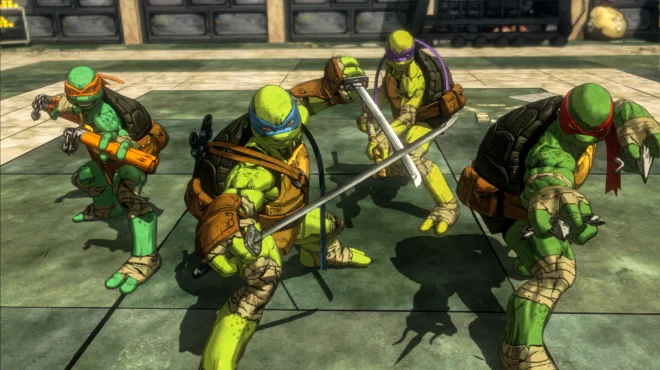
Nickelodeon’s 2012 animated series opened another door for TMNT games. Its characters could support console adventures, touchscreen apps, and new arcade cabinets. The result was a scattered decade. Some games revived familiar ideas, while others sought an audience on different screens and through different business models.
2013: Out of the Shadows and Another Game Called TMNT
TMNT: Out of the Shadows (2013), developed by Red Fly Studio and published by Activision, focused on 3D combat and co-op. It first arrived on PC and Xbox 360; the PS3 edition followed in 2014. It drew on the Nickelodeon era while giving the characters a look of its own. The original Xbox Wire announcement places it in that launch campaign.
Its title creates an easy mix-up: this is not a tie-in to the 2016 movie Out of the Shadows. The game had come out three years earlier. Two works sharing a subtitle does not establish a direct adaptation between them.
There was also Teenage Mutant Ninja Turtles (2013), developed by Magic Pockets for Xbox 360, Wii, and Nintendo 3DS and published by Activision. Its visual connection to the animated series was more immediate. The GameSpot listing and Nickelodeon and Activision announcement distinguish it from Out of the Shadows. Calling something “the 2013 TMNT game” is not enough; the subtitle or platform matters.
2014: A Movie Tie-In on 3DS and Exploration in Danger of the Ooze
The 2014 TMNT game for Nintendo 3DS, another Magic Pockets and Activision production, was tied to that year’s live-action movie. Nintendo’s official listing confirms the studio and edition. Its character designs, setting, and release context separate it from the 2013 television-based game.
Danger of the Ooze (2014) went in another direction. WayForward developed a side-scrolling action adventure with nonlinear exploration for Activision on Xbox 360, PS3, and 3DS. Switching Turtles and moving through connected spaces linked it to Radical Rescue’s exploratory branch, despite its different visual universe. Activision’s launch announcement places the story between the show’s second and third seasons.
In 2015, Master Splinter’s Training Pack bundled the television-based 2013 TMNT game and Danger of the Ooze on 3DS. It is a collection of two earlier games, rather than a new adventure to count as a third entry. That distinction matters when organizing a physical collection: a new release can contain games with earlier origins.
2016: PlatinumGames Takes Manhattan
Mutants in Manhattan (2016) paired PlatinumGames with Activision on PS4, PS3, Xbox One, Xbox 360, and PC. It used a comic-inspired visual style and a story by Tom Waltz. PlatinumGames’ official page records the team and its features.
Its four-player co-op was online. It should not be recommended as though it offers the same couch session as a 1990s arcade game. Individual abilities and team techniques aimed to give each Turtle an identity, but familiar characters do not guarantee a familiar multiplayer setup.
That premise makes for an interesting comparison. Platinum builds its action around 3D movement, abilities, and encounters; Konami’s classics draw much of their strength from the rhythm of a side-scrolling journey. Both involve fighting, but they are working toward different kinds of combat.
Mobile Games Belong in the Timeline, Too
The apps were more than a footnote. Rooftop Run (2013), tied to Nickelodeon and developed by Kung Fu Factory, turned the Turtles’ agility into a touchscreen running-and-action game. The iOS release record dates it to April 2013; Android followed later. Some reproductions of its announcement carry an incorrect year, so this timeline follows the individual releases.
Brothers Unite (2014) accompanied the movie era with mobile combat. Battle Match (2015) used matching pieces to trigger actions. Portal Power (2016) made the touchscreen a way to guide the Turtles through different dimensions, then received a PC edition in 2017. Nickelodeon’s announcements and the Steam listing document that expansion across screens.
Ludia’s Legends (2016) brought the license to turn-based RPG combat and character collecting. Mutant Madness (2020), developed by the Synapse team and published by Kongregate, combined recruiting and progression in another mobile RPG. Kongregate’s announcement confirms its worldwide launch in September 2020. Testing records and regional releases may carry earlier dates without contradicting that global launch.
The difference from a classic cartridge goes beyond the controls. Mobile games built around progression and in-app purchases create a different relationship with a player’s time. A short session may be one part of a journey that lasts weeks. For a retro fan, that shift helps explain why recognizing the characters does not always deliver the expected experience.
Arcades, Virtual Reality, and Guest Appearances
Raw Thrills created a new four-player co-op arcade game based on Nickelodeon’s series. The manufacturer’s page identifies the software with a 2017 copyright. Records also associate its commercial rollout and distribution to arcades with 2018. Those presentation and rollout periods are kept separate here, rather than turning a copyright notice into a worldwide launch date. This was an original game inspired by the arcade tradition, rather than a rerelease of Turtles in Time.
View-Master TMNT VR, an app made with Mattel and Climax Studios, also arrived in 2017. Nickelodeon’s announcement provides context for later claims about “the first TMNT game in VR.” Empire City is a standalone adventure for modern headsets, but this mobile experience came before it.
The Turtles appeared as DLC in NetherRealm and Warner Bros.’ Injustice 2 (2018) and as a crossover in Blue Mammoth Games and Ubisoft’s Brawlhalla (2021). These are appearances within other games. The Injustice 2 DLC listing on Steam and Brawlhalla’s official June 16, 2021 patch notes date them without implying they are standalone TMNT campaigns.
Making Sense of a Scattered Decade
| Branch | Examples | Key Difference |
|---|---|---|
| 3D action | Out of the Shadows; Mutants in Manhattan | Distinct settings and different co-op formats |
| Television and movie tie-ins | TMNT 2013; TMNT 2014 for 3DS | Different adaptations with different source material |
| Side-scrolling exploration | Danger of the Ooze | Connected environments and nonlinear progression |
| Apps | Rooftop Run; Battle Match; Portal Power; Legends; Mutant Madness | Controls and progression designed for mobile |
| New experiences | Raw Thrills arcade game; View-Master TMNT VR | Games and devices outside Konami’s classic catalog |
| Crossovers | Injustice 2; Brawlhalla | Content inside other games, rather than standalone TMNT titles |
The decade expanded TMNT’s presence without establishing one consistent direction. Its ups and downs make more sense as a search for formats than as ten years of the same numbered series. The 2022 revival would offer a clearer answer: preserve the past carefully and make new adventures with recognizable goals.
Continue the journey: ← Chapter 3: 2007–2011 · Series guide · Chapter 5: 2022–2025 →