
ARCADEBOT SPECIAL · MOVIES
1990
The first Ninja Turtles movie: its comic-book roots, practical creatures, different editions, and collectibles.
The first Teenage Mutant Ninja Turtles movie reached theaters in 1990 with actors inside suits, animatronic faces, and a story that made room for fights, jokes, and the brothers’ relationship with Splinter. Steve Barron directed the adaptation of Kevin Eastman and Peter Laird’s characters.
It does not continue the 1987 cartoon. This is a separate adaptation drawing much of its story from Mirage’s comics while keeping elements television had made familiar: colored masks, pizza, and a reporter named April O’Neil.
This guide covers the plot, performers, creature work, comic-book changes, home-video editions, and collectibles. The plot chapter contains full spoilers; other sections also discuss specific scenes and the ending.
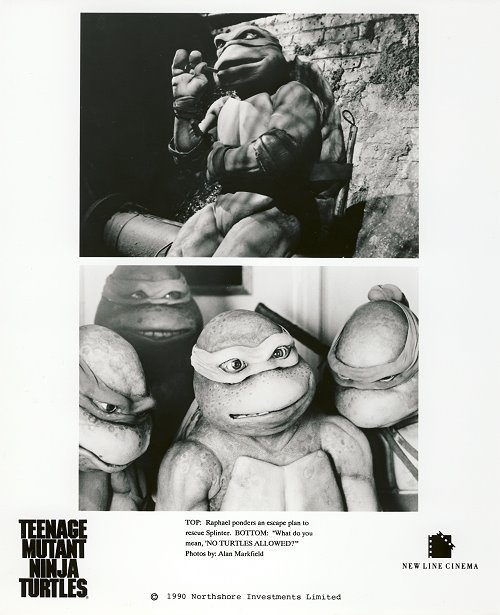
Movie Facts and Credits
| Detail | Information |
|---|---|
| Original title | Teenage Mutant Ninja Turtles |
| Common Spanish titles | Tortugas Ninja / Las Tortugas Ninja |
| Year | 1990 |
| Director | Steve Barron |
| Story | Bobby Herbeck |
| Screenplay | Todd W. Langen and Bobby Herbeck |
| Original characters | Kevin Eastman and Peter Laird |
| Producers | Kim Dawson, Simon Fields, and David Chan |
| Executive producer | Raymond Chow |
| Production companies | Golden Harvest, Limelight, and 888 Productions |
| Original U.S. distributor | New Line Cinema |
| Cinematography | John Fenner |
| Production design | Roy Forge Smith |
| Editing | William Gordean, Sally Menke, and James Symons |
| Original score | John Du Prez |
| Animatronic creatures | Jim Henson’s Creature Shop |
| Second unit and puppeteer direction | Brian Henson |
| Reference runtime | Approximately 93 minutes; varies by print and playback system |
| Original language | English |
| Original U.S. rating | PG |
The credits and production details can be checked against the American Film Institute catalog. Its U.S. PG classification is the original American rating, rather than a universal age recommendation for every territory. 1
How the Project Began
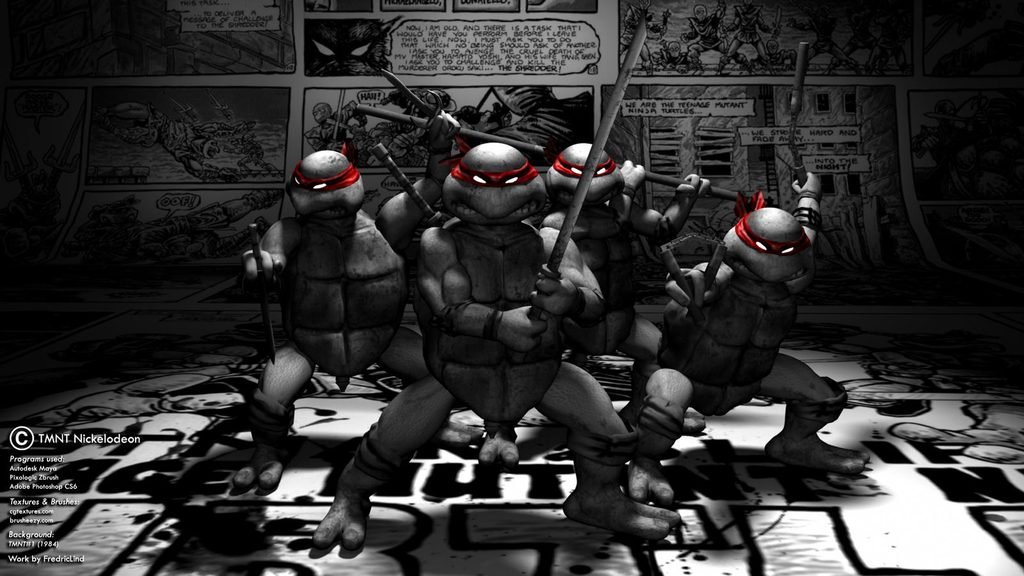
From Independent Comic to Live-Action Movie
Eastman and Laird published Teenage Mutant Ninja Turtles #1 in May 1984. The black-and-white comic introduced four mutant brothers, the teacher who raised them, and a fight with Shredder that was considerably more violent than the version later aimed at children. 2
Television and toys expanded the audience before the film arrived. The production therefore had two sets of expectations to consider: Mirage readers and children who knew the cartoon.
Producer Kim Dawson credits Gary Propper with the early push to bring the comic to theaters. In a 2020 interview, he places the project’s initial negotiations in 1987. Bobby Herbeck, then working for Golden Harvest, helped pitch it there. Selling the concept was difficult: the filmmakers remember Howard the Duck and The Garbage Pail Kids Movie being cited as cautionary examples. 3
Golden Harvest brought experience in martial-arts filmmaking and a history associated with Bruce Lee and Jackie Chan. This movie also needed something beyond capable fighters: audiences had to believe that four creature suits housed four distinct personalities.
The People Who Made It Happen
The roles matter. Eastman and Laird created the characters and participated in development and approvals. Herbeck receives the story credit and shares screenplay credit with Todd W. Langen. Dawson, Simon Fields, and David Chan are producers; Raymond Chow is executive producer. Jim Henson’s Creature Shop built the creatures, and New Line Cinema distributed the film in the United States.
The production combined Hong Kong financing and filmmaking experience, London creature fabrication, and an American shoot. That combination helps explain its character: physical martial arts and acrobatics performed by creatures designed to act in front of a camera.
Distribution nearly took another route. Accounts from Tom Gray and the producers describe a proposed Fox arrangement that fell through before New Line became involved. New Line’s distribution role should not be confused with having originated or financed every part of the project. 4
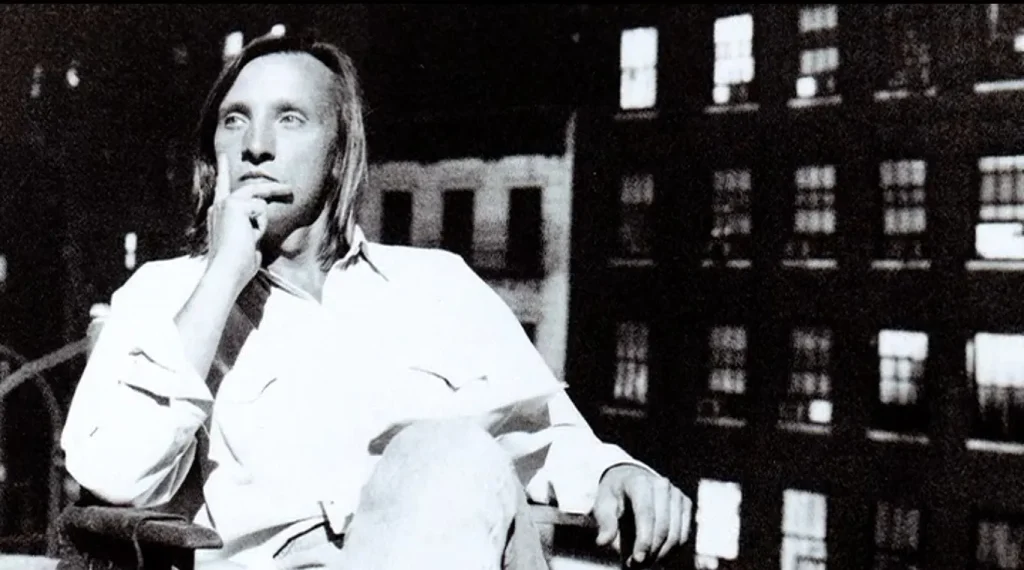
The Screenplay and Steve Barron’s Approach
Barron came from music videos and had worked in Henson’s orbit. His movie favors a nighttime city, worn interiors, and cramped spaces. The lair feels lived in: scavenged objects, mismatched furniture, and a family that has made a home beneath the street.
Three problems develop together: April investigates a theft ring, the Turtles lose their father, and Danny searches for somewhere to belong. The Foot Clan connects all three.
The brothers are not a perfectly functioning team. Raphael withdraws, Leonardo tries to hold things together, and Donatello and Michelangelo lean on humor when they do not know how to cope. Those differences create arguments and make the eventual reconciliation feel earned.
Langen has identified The Empire Strikes Back as an influence on the brothers’ spiritual development and Splinter’s role. That is an acknowledged inspiration, rather than a reason to match every scene to one from Star Wars. 4
Why the Farmhouse Sequence Matters
After its longest battle, the movie slows down. Raphael needs to recover, and the others do not know whether Splinter is alive. At the farm, they can train, live together, and talk without an enemy immediately in front of them.
Leonardo becomes more than the brother giving orders: he stays beside the injured Raph. April draws and writes, while Casey learns to live with the group. The campfire brings everyone together around Splinter’s absence. Returning to New York becomes an emotional decision as well as a practical one.
The Complete Story and Ending
April Meets Her Rescuers
A wave of thefts hits New York. Television reporter April O’Neil keeps investigating despite pressure from the police. One night, thieves attack her. Hidden by darkness, her mysterious rescuers overpower them before the officers arrive. April picks up a sai left behind.
It belongs to Raphael. He and his brothers live in the sewers with Splinter, the rat who raised them and taught them ninjutsu. Their father urges discretion; the boys celebrate and order pizza.
Raphael returns to the surface and meets Casey Jones, a hockey-masked vigilante who fights criminals with sporting equipment. Their first encounter becomes a fight because they disagree over how far that punishment should go.
Later, Raphael saves April from Foot ninjas and brings her to the lair. She meets the four brothers and hears Splinter’s account of their origin, becoming one of the few people who know they exist.
The Foot Finds the Lair
Splinter explains that he was Hamato Yoshi’s pet rat and learned by watching him practice. Yoshi and Tang Shen fled to New York to escape Oroku Saki, who eventually found and killed them. Splinter survived on the streets.
He later found four small turtles covered in a strange substance. Helping them exposed him too. All five mutated, learned to speak, and became a family. Their present lives are tied to a past that is still unresolved.
The Foot tracks the brothers home, wrecks the lair, and abducts Splinter. The Turtles take shelter with April above the Second Time Around antique shop.
Danny Pennington, the son of April’s boss, discovers them. He is involved with Shredder’s organization, which offers teenagers games, apparent freedom, and belonging. The information he takes back puts the group in danger.
Defeat and Recovery
After an argument with Leonardo, Raphael is isolated on the roof. A large Foot force overwhelms and badly injures him. The attack moves into April’s building. Casey joins the battle, but a fire forces everyone to flee.
They retreat to April’s family farm. Leonardo cares for Raphael while the brothers train and rebuild trust. Meditating around a fire, they sense Splinter and receive his message. They understand that they must return for him.
Meanwhile, Danny talks to the captive Splinter. The attention and compassion he receives contrast sharply with Shredder’s treatment. He begins to recognize that the Foot’s supposed home depends on fear.
The Final Battle
Back in New York, Casey and Danny help free Splinter. Casey fights Tatsu, the Foot’s instructor, while the young recruits have an opportunity to see how they have been used.
On a rooftop, the four Turtles face Shredder, who proves stronger than each of them individually. When Splinter arrives, he recognizes Oroku Saki. Saki recognizes the rat that scarred him years before.
Splinter turns his opponent’s attack against him, leaving Shredder suspended over the edge. The villain tries to strike with a knife, loses his support, and falls into a garbage truck. Casey activates its compactor. The first movie ends with that apparent defeat; the sequel reveals that Shredder survived.
The police arrive, Danny reunites with his father, and April and Casey grow closer. The brothers celebrate Splinter’s return. The ending brings together two troubled families: the Turtles and the Penningtons.
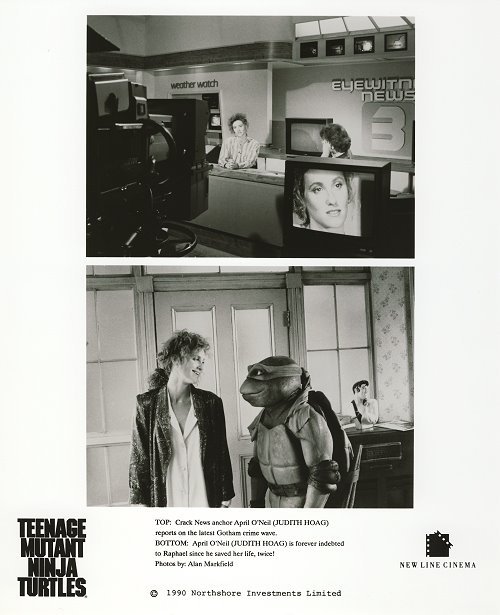
The Characters
The Four Brothers and Their Father
| Character | Weapon and mask | Role in the story |
|---|---|---|
| Leonardo | Two katanas; blue | Tries to hold the team together. His concern for Raphael reveals the affection behind their arguments. |
| Raphael | Two sai; red | Provides the main view of the brothers’ lives outside the lair. His impulsiveness leaves him vulnerable to the Foot. |
| Donatello | Bo staff; purple | Offers observation, practical solutions, and humor. Shared work and jokes build his friendship with Casey. |
| Michelangelo | Nunchaku; orange | Carries much of the comedy. Losing Splinter hurts him too, even when he does not put it into words. |
| Splinter | Ninjutsu master | The brothers’ father and teacher. His history with Yoshi and Saki explains the rooftop conflict. |
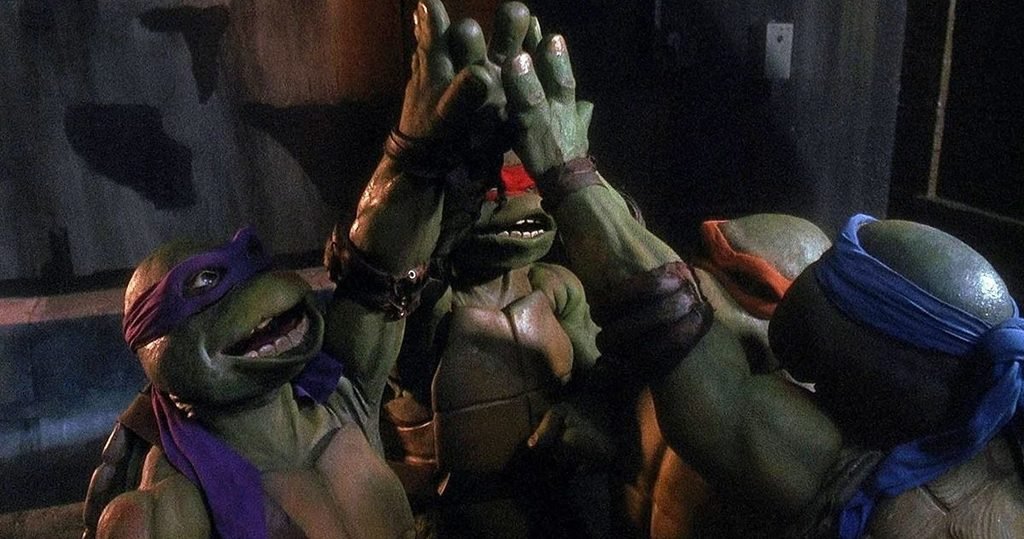
Allies, Enemies, and the Human Family
April O’Neil has a role beyond her first rescue. She investigates the crimes, shelters the brothers, and loses her home by helping them. Her professional life and personal problems exist before she joins their world.
Casey Jones shares Raphael’s anger but begins even further down the path of aggression. A hockey mask does not make him a ninja: he fights with bats, sticks, and physical force. He grows into an ally rather than remaining someone looking for another person to hit.
Shredder, or Oroku Saki, turns teenagers’ need to belong into obedience. His armor and carefully limited appearances separate him from the heroes’ comic energy.
Tatsu enforces discipline and runs the Foot’s training. He is the authority recruits face day to day. He is a separate character, not Shredder’s Japanese name.
Danny Pennington takes part in theft and betrayal, but can also choose to change. His conversations with Splinter make the Foot conflict a story about personal decisions as well as combat.
Charles Pennington is April’s boss and Danny’s father, struggling to understand his son. Chief Sterns pressures April over her reporting. Charles’s secretary June, the television staff, and the Foot recruits fill out the ordinary world around the mutants.
Hamato Yoshi and Tang Shen belong to the past Splinter recounts. Their story should not be mixed up with other continuities: in this movie, Splinter starts as a rat, rather than as Yoshi transformed.
Suit Actors, Voices, Puppeteers, and Stunt Performers
A Turtle is the work of more than one person. The performance combines a body actor, an English voice, facial puppeteering, and stunt work. International dubs add another set of performers.
Who Was Inside the Suits?
| Character | Suit performer | Original English voice | Credited animatronic puppeteer |
|---|---|---|---|
| Leonardo | David Forman | Brian Tochi | Martin P. Robinson |
| Raphael | Josh Pais | Josh Pais | David Greenaway |
| Donatello | Leif Tilden | Corey Feldman | David Rudman |
| Michelangelo | Michelan Sisti | Robbie Rist | Mak Wilson |
| Splinter | Animatronic puppet | Kevin Clash | Kevin Clash |
Josh Pais is the only principal Turtle suit actor who also supplies his character’s English voice. The puppeteer assignments below follow AFI’s collected credits; they do not imply that one operator handled every aspect of each creature. 1
The Human Cast
| Character | Performer |
|---|---|
| April O’Neil | Judith Hoag |
| Casey Jones | Elias Koteas |
| Danny Pennington | Michael Turney |
| Charles Pennington | Jay Patterson |
| Shredder | James Saito; English voice by David McCharen |
| Tatsu | Toshishiro Obata; English voice by Michael McConnohie |
| Chief Sterns | Raymond Serra |
| Young Foot recruit leader | Sam Rockwell |
| June | Kitty Fitzgibbon |
| Pizza delivery worker | Michelan Sisti |
| Taxi passenger | Josh Pais |
| Gang member | David Forman |
| Foot messenger | Leif Tilden |
Sisti, Pais, Forman, and Tilden also appear out of costume in small roles. Sam Rockwell plays one of the Foot youths, long before he became a familiar movie star.
Stunts and Supporting Roles
Pat Johnson coordinated stunts and martial-arts choreography. The Turtle stunt credits include Yuen Mo Chow, Choi Nam Ip, Chi Wai Chiang, Kenn Troum—also known as Kenn Scott—Reggie Barnes, and Ernie Reyes Jr. Reyes is specifically associated with Donatello. A credit list alone cannot identify the performer behind every jump. 1
Supporting performers include Louis Cantarini, Joseph D’Onofrio, John D. Ward, Ju Yu, Cassandra Ward-Freeman, Mark Jeffrey Miller, John Rogers, Tae Pak, Robert Haskell, Joshua Bo Lozoff, Winston Hemingway, and Joe Inscoe. Keeping those names helps when comparing credits, since databases can differ in spelling and uncredited-role assignments.
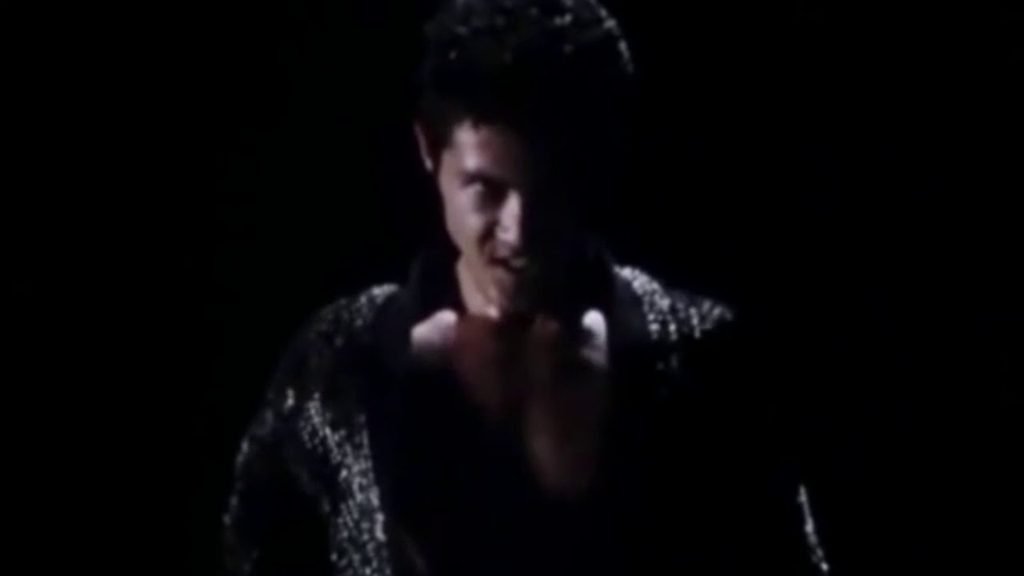
Jim Henson’s Creature Shop: How the Turtles Worked
One Character, Several Performers
Foam-latex suits covered forms built for each creature. Dialogue heads used mechanisms to move eyes, eyelids, and mouths. Animatronics animate a physical object through controlled mechanisms; these were not computer-generated faces.
The press kit places the start of construction in February 1989. It names John Stephenson and William Plant in supervision and Dave Housman in electronics development. Brian Henson coordinated performances and directed the second unit. 5
The suit actor supplied posture, timing, and physical intention. Outside operators completed the expression. The same head tilt could seem shy, defiant, or funny depending on the eyes and mouth that accompanied it.
Dawson distinguishes acting and dialogue suits from those used for action. Controls included devices known as waldos, which translated an operator’s movement into the creature’s. Electronics expanded the acting possibilities, while heat and sweat complicated maintenance. 3
Why They Do Not Look Like Four Copies
The differences extend beyond mask color to head shape, body finish, expressions, and movement. Even in a quiet conversation, Raphael occupies space differently from Donatello.
Shadows are part of the effect too. They help foam, cloth, and machinery sit naturally within the city’s textures. They can also make colors and details harder to read, particularly in older video copies. The atmosphere comes with that tradeoff.
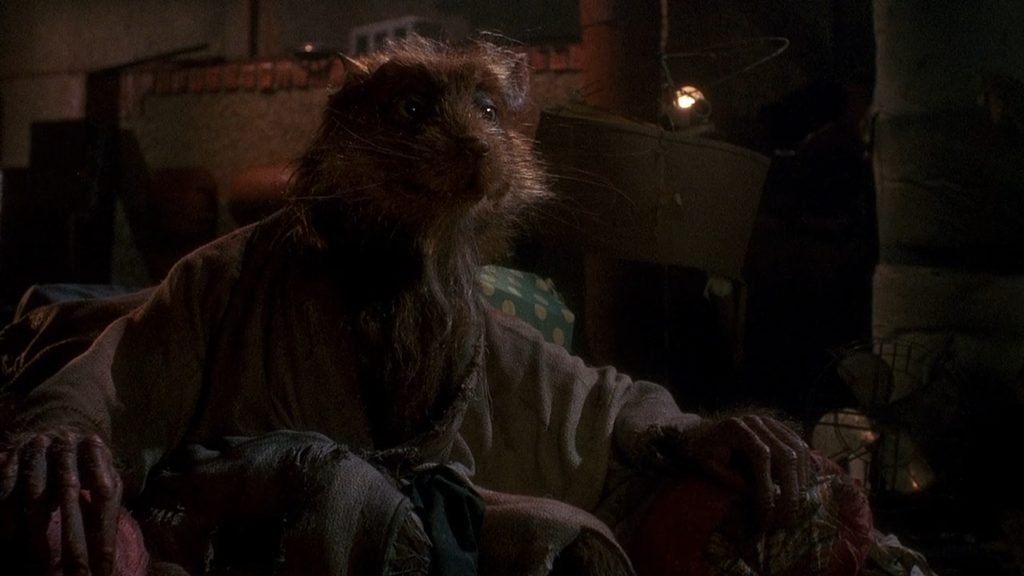
Splinter and Jim Henson’s Role
Splinter is an animatronic puppet rather than a full-bodied human performer in a rat suit. His framing and movement use puppetry especially well in conversations where listening is more important than action.
Steve Barron directed the movie. Calling it “a Jim Henson movie” can acknowledge its creature work, but is misleading if presented as a directing credit. Henson’s workshop and collaborators were essential to bringing the characters to life.
Henson died on May 16, 1990, after the film’s March U.S. release. The dedication “In memory of Jim Henson” belongs to the second movie, an important distinction in the trilogy’s history. 36
Filming, Locations, and Action
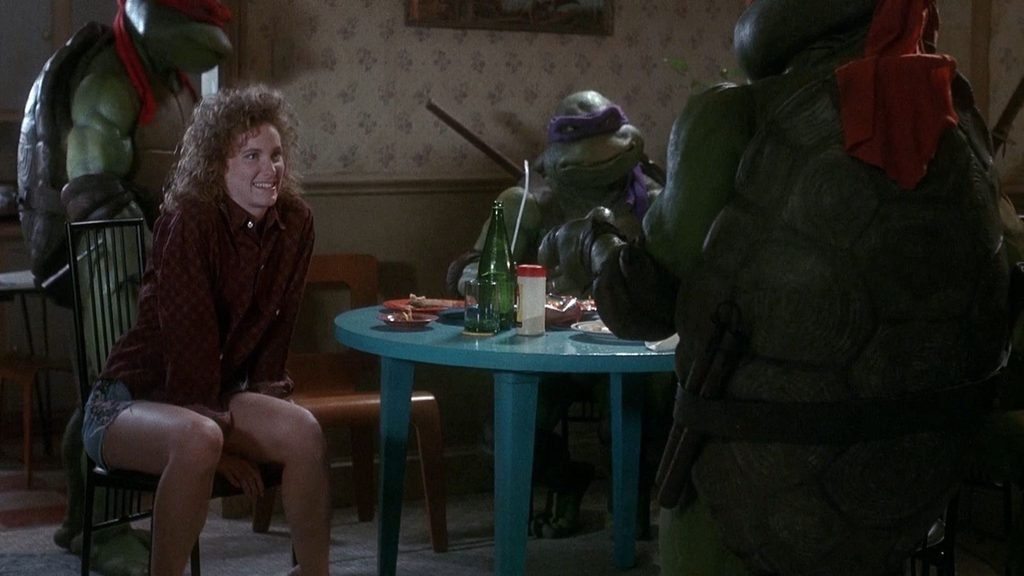
New York on Screen, North Carolina Behind the Camera
The story takes place in New York, but production worked mainly in Wilmington, North Carolina, with additional New York filming. AFI records principal photography beginning on July 7, 1989, with production continuing into mid-September. 1
| Production location | Connection to the film |
|---|---|
| Wilmington studios | Sets allowing controlled lighting, cameras, creature performances, and action. |
| Wilmington and surrounding area | Streets and buildings used to complete the story’s screen version of New York. |
| Currie area, North Carolina | Documented farmhouse location. |
| New York and Brooklyn | Exterior photography in the city that defines the setting. |
The photographic archive Then & Now Movie Locations compares filming sites with later images. Those comparisons are historical documentation rather than a guarantee of current access: buildings change, and some locations are private property. 6
Four Fights That Move the Story Forward
Raphael and Casey: Casey first appears as Raph’s problem, not his immediate friend. Their disagreement establishes methods and personalities before they can become a team.
The rooftop ambush: Raphael has not forgotten how to fight. He is isolated and outnumbered. A family argument leads directly to physical consequences.
April’s shop: several fights unfold inside a space being destroyed. Casey helps everyone escape but cannot save their refuge. It is a defeat, despite the jokes and spectacular action.
Shredder versus the brothers: the villain poses a different challenge from his soldiers. Splinter’s arrival restores the conflict’s personal history and changes who can resolve it.
Behind-the-Scenes Stories with Identifiable Sources
In The Ringer’s oral history, performers recall suits weighing around 70 pounds and the feeling of confinement. Barron describes supports that allowed them to rest without removing everything. Those are production memories, rather than measurements of every suit variation. 4
In the same interview, Judith Hoag remembers Robin Williams immediately recognizing the project and becoming excited that she would play April. The crew also describes radio interference affecting facial mechanisms. Together, the accounts show how delicate technology and demanding physical work shaped the shoot. 4
Deleted Scenes and Alternate Versions
The Comic-Publisher Ending
The filmmakers shot an epilogue in which April and Danny pitch the Ninja Turtles to a comics publisher. The joke is that he finds the idea implausible while the actual Turtles are close to the window.
Ninja Pizza preserves photographs and a script excerpt. Arrow includes an alternate ending sourced from a VHS workprint. The epilogue therefore has documentary support beyond a fan memory. 7 8
A workprint is an editing-stage version that can contain provisional material and lower-quality footage. Its existence does not prove that every scripted scene belongs to a completed, authorized extended edition.
Written, Filmed, and Released Are Different Things
A comic adaptation can preserve something from a script that never reached the theatrical cut. A still photograph can show that a situation was prepared or photographed, but cannot reconstruct the full scene by itself.
Barron and the producers disagreed about tone and completion. AFI also documents later profit disputes. Those production conflicts should be described through the evidence, without turning them into a conspiracy or assuming a lost definitive cut exists. 1
The British Cuts
The BBFC records a cut 1990 theatrical version and a November 2003 approval removing the earlier cuts. Specialized comparisons identify changes involving martial-arts weapons, including nunchaku. 9 10
Arrow includes alternate British material prepared for censorship requirements and alternate Korean footage. It is better to identify particular versions: a runtime difference can come from cuts, editing, or video playback speed.
Differences from Mirage and the 1987 Cartoon
It Adapts More Than Issue #1
Splinter’s connection to Yoshi and Shredder and the rooftop confrontation recall Mirage #1. Raphael’s meeting with Casey comes from Raphael: Me, Myself and I. The attack and rural retreat connect with Leonardo: What Goes Around… Comes Around! and issues #10–11. 2 11 12
A major change is which brother receives the beating. In the Mirage storyline, it is Leonardo; the movie gives the injury to Raphael. That choice connects it to Raph’s impulsiveness and lets Leo become the brother caring for him.
The farmhouse’s family connection changes too: it is associated with Casey in that comic storyline, but with April’s family in the film. Mirage’s Splinter is present during the retreat; the movie builds much of its emotional conflict around his absence. 12
| Element | Early Mirage | 1987 cartoon | 1990 movie |
|---|---|---|---|
| Masks | Red in the original color depictions | A different color for each brother | Keeps all four colors |
| Splinter | Yoshi’s pet rat | Hamato Yoshi transformed into a rat | Yoshi’s rat, later mutated |
| April | Initially works in science | Channel 6 reporter | Television reporter |
| Foot Soldiers | Human warriors | Frequently robots | Humans and teenage recruits |
| Shredder | Revenge involving Yoshi and the Oroku family | Recurring villain partnered with Krang | Saki controls a criminal organization |
| Other enemies | Many groups appear as the world expands | Krang, Bebop, and Rocksteady are regulars | Those three characters do not appear |
| Tone | More violence and lethal consequences | Comedy and adventure for children’s television | Physical action, humor, and family conflict |
These comparisons concern specific versions. Later TMNT continuities change origins and relationships repeatedly. 2 13
The Soundtrack Album and Original Score
What Was on the 1990 Album?
SBK’s commercial album combined songs with a few instrumental tracks. It was not a complete release of every piece of music composed for the film. 14
| Track | Artist |
|---|---|
| This Is What We Do | M.C. Hammer |
| Spin That Wheel | Hi Tek 3 |
| Family | Riff |
| 9.95 | Spunkadelic |
| Turtle Power | Partners in Kryme |
| Let the Walls Come Down | Johnny Kemp |
| Every Heart Needs a Home | St. Paul |
| Shredder’s Suite | John Du Prez |
| Splinter’s Tale I & II | John Du Prez |
| Turtle Rhapsody | Orchestra on the Half Shell |
“Turtle Power” reached number one in the United Kingdom and stayed there for four weeks, according to Official Charts. Its success extended well beyond the movie theater. 15
John Du Prez’s Score
The score supports Shredder’s menace, the fights, and Splinter’s emotional scenes. It helps the movie take a family moment seriously when the image might otherwise look like a joke about people in costumes.
Waxwork released the complete score restored from the masters, working with Du Prez, Eastman, and Nickelodeon. Eastman’s artwork accompanies that edition, which is different from SBK’s song compilation. For collectors, “soundtrack” and “score” do not always mean the same contents. 16
International Releases and Home Video
The U.S. theatrical release was March 30, 1990. AFI distinguishes it from the March 24 charity premiere in Universal City. The film did not open everywhere in the world at once. 1
| Territory | Recorded release date | Source and qualification |
|---|---|---|
| United States | March 30, 1990 | Theatrical opening; AFI |
| Canada | March 30, 1990 | 25th Frame and IMDb |
| Mexico | August 2, 1990 | General release in 25th Frame; IMDb also records a July 31 limited opening |
| Brazil | September 21, 1990 | 25th Frame |
| Colombia | November 21, 1990 | 25th Frame; secondary-database record |
| United Kingdom | November 23, 1990 | 25th Frame |
| Spain | November 27 in ICAA; November 30 in 25th Frame | Sources disagree; both attributed dates are retained |
| Peru | December 10, 1990 | 25th Frame; secondary-database record |
| France | December 12, 1990 | 25th Frame |
| Argentina | December 13, 1990 | 25th Frame; secondary-database record |
| Germany | December 13, 1990 | 25th Frame |
| Japan | March 13, 1991 | 25th Frame |
International dates come from distribution records and film databases. A premiere, limited engagement, and general opening can differ. The conflicting Spanish dates below remain attributed to their respective sources rather than forced into a single answer. 17 18 19
The American VHS campaign announced an October 4, 1990 release through Family Home Entertainment/LIVE. Contemporary trade coverage documents its Pizza Hut promotion. Remembering that brand from the tape does not contradict Domino’s appearing in the movie; the partnerships belong to different parts of its marketing. 20
Budget and Box Office
| Measure | Amount in U.S. dollars |
|---|---|
| Commonly cited budget | $13.5 million |
| Opening weekend in the U.S. and Canada | $25,398,367 |
| Original domestic release gross in Box Office Mojo | $135,265,915 |
| Domestic total including recorded rereleases | $135,384,756 |
| International gross in the global listing | $66,700,000 |
| Worldwide total in the global listing | $202,084,756 |
In American box-office reporting, “domestic” means the United States and Canada. The figures below preserve the Box Office Mojo snapshot dated October 20, 2026. Its release groupings do not all provide the same level of international detail. 21
The success made it a landmark for filmmaking outside the major studios, and historical accounts describe it as the highest-grossing independent film of its time. That does not make it the current record holder or mean that independent production involved no substantial companies or distributors.
Nor can you subtract the production budget from box office and call the remainder profit. Theaters take a share, and distribution and advertising add costs. Gross revenue measures commercial reach without telling us exactly what every participant earned.
Reviews and a Fresh Look
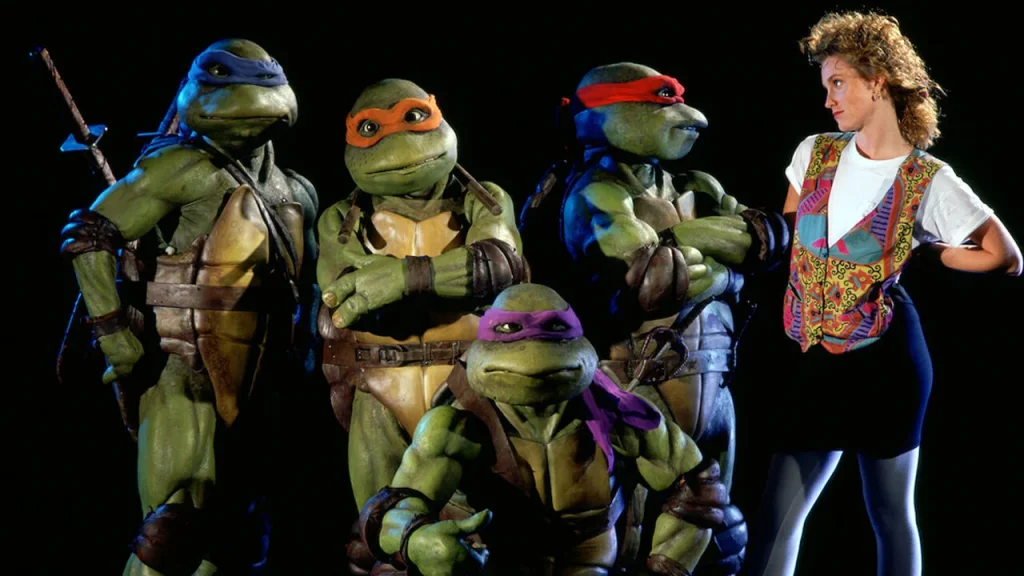
The original response was mixed. Roger Ebert awarded two and a half stars out of four and found much of what fans would want. Other reviews questioned the dark photography, slower stretches, and portrayal of Asian villains, while some praised the comedy and action. 22 13
There is no need to reduce that disagreement to critics versus fans. You can admire the suits and family relationships while noticing jokes that aged badly or scenes in which the characters are hard to distinguish.
What holds up best is that losses have consequences. Destroying a home does more than move the plot to another fight. Raphael must heal, April loses something of her own, and the brothers have to work together again. The comedy exists alongside those problems rather than erasing them.
There are limits too. The criminal plan is simple, and the plot takes shortcuts to reach its finale. The movie’s strength lies less in a complicated mystery than in the relationships built along the way. That is ArcadeBot’s reading of the film, rather than a statement from its makers.
Dubs and Home-Video Editions
Why the Spanish Voices May Sound Different
The film has multiple Latin American Spanish dubs. Identifying “Raphael’s Spanish voice” therefore requires a country, distributor, and edition. The cast below belongs to the Mexican VHS dub documented by Doblaje Wiki, a specialist community database. 23
| Character | Voice in the Mexican VHS dub |
|---|---|
| Leonardo | Luis Alfonso Mendoza |
| Donatello | Sergio Bonilla |
| Raphael / Rafael | Jorge Santos |
| Michelangelo / Miguel Ángel | Jorge Roig |
| Splinter | Alejandro Villeli |
| April O’Neil | Mónica Manjarrez |
| Casey Jones | Guillermo Sauceda |
| Shredder / Destructor | Herman López |
| Tatsu | Miguel Ángel Ghigliazza |
The same database records other versions for television and other markets, including Colombia. This table should not automatically be applied to a recent broadcast or imported disc. A particular copy’s audio and credits are the relevant evidence.
Spain’s theatrical Spanish dub has its own 1990 record on eldoblaje.com. Its performers differ from the Latin American casts. 24
VHS, DVD, Blu-ray, and 4K: What to Check
| Format or edition | What to check |
|---|---|
| VHS | Country, distributor, video system, dub, and whether the source is a cut version. |
| DVD | Disc region, framing, languages, and cut. A DVD release does not guarantee supplements or a new restoration. |
| Blu-ray | Master quality, audio, subtitles, and contents of the individual release or box set. |
| Arrow 4K | Restoration from the original negative approved by Barron; Dolby Vision with HDR10 compatibility; supplements and alternate versions. |
Arrow’s trilogy edition includes the 1990, 1991, and 1993 films. For the first, its specifications list stereo audio, a new Dolby Atmos mix, commentaries, interviews, and a locations documentary. The U.S. listing specifies English subtitles; it does not promise Latin American or European Spanish dubbing. 8
A film running around 93 minutes at theatrical speed can run closer to 90 with PAL speed-up. That difference alone is not proof of censorship. Compare scenes and edition details rather than relying only on the runtime display.
Streaming availability changes by country and contract. Use the year, director, and cast to distinguish this movie from the 2014 reboot rather than trusting a title that only says Teenage Mutant Ninja Turtles.
Comics, Trading Cards, and Collectibles
What Actually Comes from This Movie?
A 1990 copyright stamp does not prove that a toy adapts the film. It could belong to the cartoon, the general toy line, or a reissue retaining an old mold date. Identification requires the product name, sculpt, packaging, and manufacturer’s catalog.
| Collectible type | Documented example | Distinguishing details |
|---|---|---|
| Comic adaptation | Teenage Mutant Ninja Turtles: The Movie, Mirage, 1990 | Retells the feature film in comics. |
| Comic parody | Green-Grey Sponge-Suit Sushi Turtles, Mark Martin, 1990 | A parody of the movie, separate from its straightforward adaptation. |
| Trading cards | Topps, 1990 movie set | Cast and creature photographs; 132 cards and 11 stickers. |
| Vintage figures | Playmates Movie Star line | Movie-inspired designs; some releases came after the film’s opening. |
| Modern figures | NECA movie line | Various scales and accessories based on the live-action characters. |
| Music | SBK and Waxwork | Song compilation compared with the complete original score. |
| Promotional material | Posters, press photographs, advertisements, and programs | Vary by territory, distributor, and campaign. |
The Comic That Adapts an Adaptation
Mirage published The Movie in 1990. Its archive credits Eastman, Laird, and Jim Lawson; Kevin Eastman Studios also identifies Eric Talbot and Gary Fields’s work on the edition. The characters travel from comics to film, then the film returns to paper. 25 26
A difference in that adaptation is not automatically evidence of a last-minute film change. Comics make their own choices. It is useful for comparing condensed scenes, explanatory narration, and material that differs from the theatrical cut.
Mark Martin’s Green-Grey Sponge-Suit Sushi Turtles is a separate 1990 parody, with 48 story pages according to Mirage. It belongs in a different catalog entry from the straightforward movie adaptation. 27
Topps Cards, Stickers, and Albums
The 1990 Topps movie set contains 132 cards and 11 stickers. It is different from card sets featuring cartoon illustrations. Manufacturer material and specialist checklists help identify the contents. 28 29
“1990 Ninja Turtles album” is too broad a description for a remote purchase. Ask for photos of the cover, publisher, copyright information, and interior. Different territories had different collections, and modern reproductions also exist. The year alone does not identify one worldwide release.
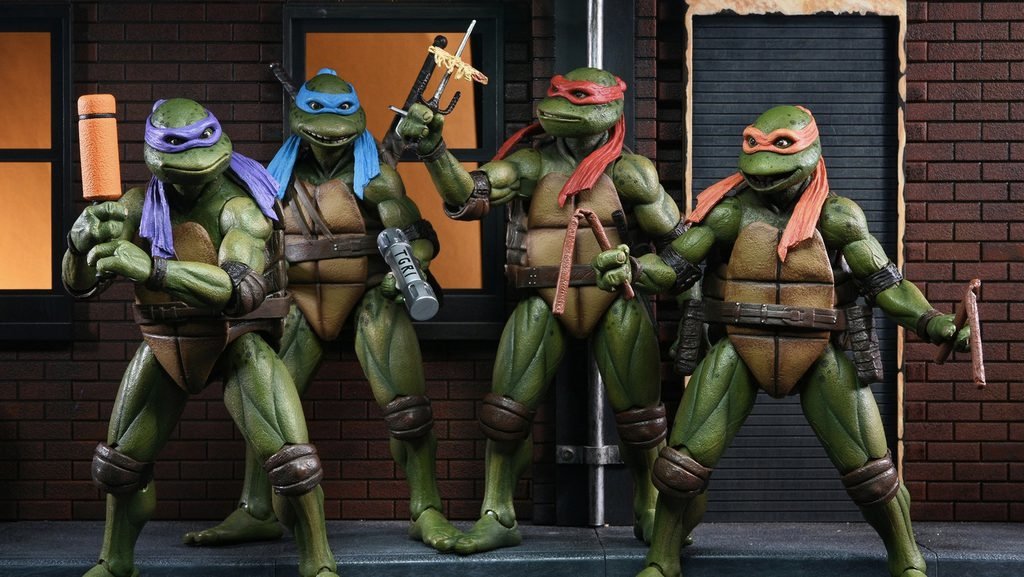
Playmates and NECA
NECA’s 1990 movie figures appeal because they reproduce the practical characters’ appearance: skin texture, spots, shells, and expressions. Each brother has distinct facial and shell details, especially noticeable when all four are displayed together. Toyark’s review of the first seven-inch set also praised its paint and movement.
For collectors, the key is to choose a scale, identify the edition, and check the actual box contents. NECA has released several versions. The most expensive is not necessarily the best match for your collection.
| Format | What it offers | Things to consider |
|---|---|---|
| 7-inch line | A practical size for collecting characters and staging scenes. | “7-inch” identifies the line’s format; check each figure’s actual height. |
| Quarter scale | Turtles approximately 16½ inches (42 cm) tall, with a larger display presence. | Require substantial space, with accessories sized differently from the smaller line. |
The quarter-scale Turtles have roughly 30 points of articulation; Raphael, for example, stands about 16½ inches tall. Measure the display space with the intended weapons and pose in mind.
Here are the details worth comparing:
- The edition and its actual changes. Releases include individual figures, two-packs, and special sets. The first seven-inch four-pack used VHS-inspired packaging. Later examples include 35th-anniversary Ultimates and a set with the four brothers and Splinter’s spirit. Compare the sculpt, paint, accessories, and package; a new box does not by itself mean every part was resculpted.
- The included accessories. Check the exact release’s list. Hands, pizza pieces, bandana tails, and other extras vary. The 35th-anniversary Ultimate Leonardo includes swords, additional hands, a campfire, newspaper, mutagen container, and pizza-related pieces. A separate accessory pack adds expressions for the brothers and movie objects, but does not include the figures themselves.
- The movie represented. Look specifically for “1990 Movie.” NECA also makes figures from sequels, cartoons, and comics. If you want a visually consistent first-movie collection, compare faces, costumes, and product references before combining releases.
- Authenticity and the seller. Collectors have reported receiving copies of these figures online. Ask for photos of the actual item, review the seller’s history, and check return terms. A low price, uneven paint, or branded box cannot independently prove or rule out a counterfeit. Provenance is more useful than a supposedly infallible visual trick.
- Condition. For a used figure, request close-ups of the eyes, teeth, hands, joints, and shell. Ask about repairs, glued parts, paint touch-ups, and missing accessories, especially the character’s weapons. Move joints gently when the figure arrives, and stop if one strongly resists. A sealed package lets you inspect less of its mechanical condition.
- Packaging and storage. If you collect in the box, check corners, windows, seals, and outer sleeves. NECA’s store notes that it does not guarantee pristine packaging and that minor wear may not qualify for an exchange. For open displays, use a stable spot away from direct sun and label stored small parts by character and release.
NECA’s range extends to supporting characters, the baby Turtles from the origin sequence, and scene-specific accessories in different scales. That variety shows how one film can keep inspiring collectible designs decades later. 32 33
Scale and contents matter more than the shared TMNT logo. A quarter-scale Turtle is not part of a seven-inch display set, and a sequel’s villain or accessory may not belong in a scene from the first movie.
Promotional Material and Period Objects
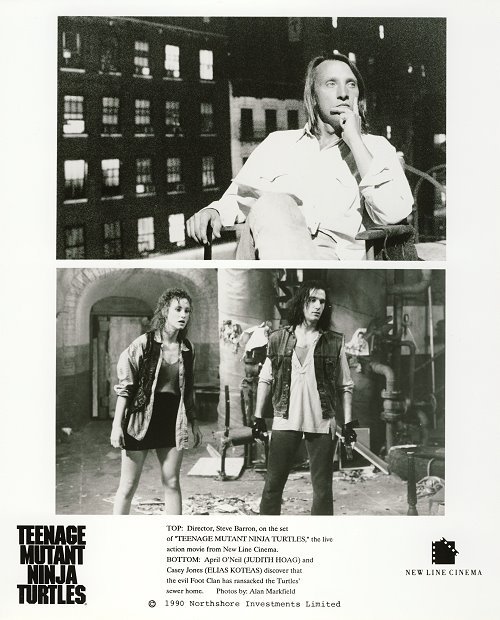
The original press kit supplied journalists with photographs and production notes. The sheets reproduced here retain captions and credits, documenting how April, the Turtles, and Barron were presented in the original campaign.
The American VHS and Pizza Hut promotion represent another part of the experience: bringing the film home. A brand’s sponsorship does not make every TMNT product it promoted a story-based spinoff of the movie.
An original poster, licensed reproduction, and homemade print can use the same image while being very different objects. Record dimensions, printer or distributor, country, condition, and provenance. A seller’s asking price is not proof of market value.
Related Video Games and Common Mix-Ups
The movie arrived during Konami’s gaming success, but the 1989 NES and arcade games predate its release. They do not recreate the movie’s rescue of Splinter and final confrontation scene by scene.
The “II” in Teenage Mutant Ninja Turtles II: The Arcade Game does not make it an adaptation of The Secret of the Ooze. It numbers the NES game series. Movie and video-game numbering are not interchangeable.
The Hyperstone Heist on Genesis includes Tatsu, a recognizable movie connection. That still does not make it a complete adaptation of the film. Game coverage documents his appearance, and Konami includes the title in The Cowabunga Collection. 34 35
Konami describes the collection’s classics through their comic and cartoon characters and themes, a useful way to keep the franchise’s different branches separate.
For the full gaming story, continue with the first TMNT video games and their golden age, from 1989 to 1993. That article covers the games in detail while this guide stays focused on the movie.
Sequels and Legacy
Teenage Mutant Ninja Turtles II: The Secret of the Ooze followed in 1991, directed by Michael Pressman. It brings Shredder back and introduces Keno, Tokka, and Rahzar. Paige Turco replaces Judith Hoag as April. Stuart Gillard’s third film arrives in 1993 and takes the adventure into Japan’s past. 8 36
Ernie Reyes Jr. moves from performing Donatello’s action to playing Keno in the sequel, giving a visible role to someone whose face had been hidden in the first movie.
The 2014 film introduces a separate continuity rather than serving as a fourth chapter of this story. Include the year or Barron’s name when you want to identify the original precisely.
The 1990 film’s legacy appears in restorations, new interviews, figures recreating its suits, and editions of its music. It also survives in a familiar image of the Turtles: brothers who argue, joke, and need their father.
To explore the character at the center of that family, read our guide to Master Splinter’s origins. His changing history explains why TMNT does not always tell the same story about how the family began.
Timeline
| Date | Event |
|---|---|
| May 1984 | Mirage publishes TMNT #1. |
| 1987 | The cartoon begins; Dawson dates initial film negotiations to this year. |
| February 1989 | Creature construction begins, according to the press kit. |
| July–September 1989 | Production period recorded by AFI. |
| March 24, 1990 | Charity premiere in Universal City. |
| March 30, 1990 | U.S. theatrical opening. |
| Summer 1990 | Movie comic adaptation recorded by Mirage. |
| July–August 1990 | “Turtle Power” reaches number one in the U.K. and stays for four weeks. |
| October 4, 1990 | Announced American VHS release date. |
| 1991 | The Secret of the Ooze is released. |
| 1993 | Teenage Mutant Ninja Turtles III is released. |
| 2003 | The BBFC removes earlier cuts in a new theatrical approval. |
| 2018 | Waxwork releases Du Prez’s complete score. |
| 2025 | The film turns 35; Arrow releases its restored trilogy edition. |
Frequently Asked Questions
What was the first Ninja Turtles movie?
Teenage Mutant Ninja Turtles, directed by Steve Barron and released in 1990, with Judith Hoag as April and Elias Koteas as Casey.
Are the Turtles actors in suits or digital effects?
They are physical characters created through suits, body performances, animatronics, and stunt work. Operators outside the costumes control facial mechanisms, while voice performances complete the characters.
Did Jim Henson direct it?
No. Steve Barron directed. Jim Henson’s Creature Shop built the creatures, and Brian Henson directed the second unit and coordinated puppeteering.
Who voices Donatello?
Corey Feldman provides his English voice, while Leif Tilden is the principal suit performer. Spanish voices depend on the dub; the Mexican VHS version listed here uses Sergio Bonilla.
Why isn’t Splinter Hamato Yoshi?
This movie follows the origin in which Splinter is Yoshi’s pet rat. Yoshi himself turning into Splinter belongs to other versions, including the 1987 cartoon.
Do Krang, Bebop, and Rocksteady appear?
No. Shredder and Tatsu lead the Foot conflict in the 1990 film. Tokka and Rahzar belong to the 1991 sequel.
Does it adapt the comic or the cartoon?
It combines Mirage storylines and relationships with traits popularized by television. It has its own continuity, so you do not need to have read the comics or watched the show first.
Is there an alternate ending?
Yes. The comic-publisher epilogue survives in workprint material included by Arrow. That does not establish the existence of an entire finished extended feature.
Why does my copy run around 90 minutes?
PAL speed-up can explain some of the difference from an approximately 93-minute theatrical presentation. Cut versions also exist. Identify the particular edition before concluding that scenes are missing.
Does the 4K edition include Spanish?
The U.S. Arrow listing specifies English audio and English subtitles. Check the exact edition rather than assuming it includes Latin American or European Spanish.
How much did it make?
Around $202 million worldwide in Box Office Mojo’s global listing, against a commonly cited $13.5 million budget. Gross revenue is not the same as profit.
Which movies come next?
The direct sequels in this trilogy are The Secret of the Ooze (1991) and Teenage Mutant Ninja Turtles III (1993).
Sources and Image Credits
Editorial approach: this guide draws on credits, film archives, original promotional documents, and identifiable testimony. Community databases and collector archives are labeled as such. Interview memories remain attributed, and conflicting release dates are preserved. The original source register is dated October 20, 2026; selected edition specifications and production records were checked again on October 24.
- American Film Institute: Teenage Mutant Ninja Turtles (1990). Credits, production history, and references to contemporary trade coverage.
- Mirage: TMNT, volume 1, issue #1. Publisher record and original comic synopsis.
- Kim Dawson and Bobby Herbeck interview, republished by Renee Witterstaetter, 2020. Producer and screenwriter testimony.
- The Ringer: Green Screen: The Oral History of Teenage Mutant Ninja Turtles, March 31, 2020. Interviews with the filmmakers and performers.
- Original 1990 press kit, archived by Ninja Pizza. Contemporary promotional material and photographs.
- Then & Now Movie Locations: Teenage Mutant Ninja Turtles. Photographic comparisons of filming sites.
- Ninja Pizza: Alternate Ending. Photographs and a script excerpt from the epilogue.
- Arrow Video: Trilogy Limited Edition 4K UHD. Publisher specifications for restoration, audio, subtitles, and supplements.
- BBFC: Teenage Mutant Ninja Turtles classification history. Official British record.
- Movie-Censorship: British VHS and DVD comparison. Specialist reference on cuts and alternate footage.
- Mirage: Raphael, Leonardo, and TMNT #10. Publisher records for stories compared with the film.
- Mirage: TMNT, volume 1, issue #11, True Stories. The farmhouse retreat.
- Teenage Mutant Ninja Turtles (1990 film), Wikipedia. Secondary cross-reference and guide to historical reviews.
- FilmMusic: SBK album K2-91066. Ten-track listing and formats.
- Official Charts: Turtle Power, Partners in Kryme. Official British chart record.
- Waxwork Records: Teenage Mutant Ninja Turtles original score. Publisher description and track list.
- 25th Frame: International release dates. Secondary database covering Colombia and other Latin American markets.
- ICAA: Film record 52052. Spanish record; the original research used an indexed date because direct access was limited.
- IMDb: Release information. Indexed cross-reference for Canadian and Mexican openings.
- Billboard, August 11, 1990, home-video section. Contemporary coverage of the VHS release and Pizza Hut promotion.
- Box Office Mojo: Teenage Mutant Ninja Turtles. Budget and box-office records separated by release.
- Roger Ebert: 1990 review. Historical review; the original register located the text through indexing and cross-checked the rating.
- Doblaje Wiki: Las Tortugas Ninja. Community database of Latin American dub casts and samples.
- eldoblaje.com: 1990 Spanish theatrical dub. Spain’s cast record, located through indexing in the original research.
- Mirage: Specials. Related publications and dates.
- Kevin Eastman Studios: 35th anniversary, March 30, 2025. Comic adaptation and collectible material.
- Mirage: Green-Grey Sponge-Suit Sushi Turtles. Mark Martin’s parody.
- Topps Ripped: The 1990 set. Manufacturer’s collecting feature, located through indexing.
- Trader Cracks: 1990 Topps checklist. Specialist card archive.
- Action Figure 411: Movie Star Leo. Toy identification and release year; advertisements are not treated as appraisals.
- TMNT Toys: 1992 basic assortment. Figure archive.
- NECA: Movie Baby Turtles set. Official product catalog.
- NECA: 1990 movie product archive. Official licensed-product catalog.
- Retro Andy: The Hyperstone Heist. Identifies Tatsu’s game appearance.
- Konami: The Cowabunga Collection. Official game list and description of the collection’s sources.
- AFI: The Secret of the Ooze. Sequel credits and historical documentation.
Film discussed: Teenage Mutant Ninja Turtles (Steve Barron, 1990). The plot account and scene analysis are written for this guide, rather than reproducing the screenplay or extended dialogue.
Photographs: Alan Markfield; New Line Cinema promotional material, © 1990 Northshore Investments Limited, as identified in the printed captions. Scans are archived by Ninja Pizza. Three press-kit sheets appear here with visible credits in the context of discussing the film. They are not public-domain photographs and are not offered under an open license. The image records retain their provenance and editorial context.