Magic TMNT brings the Ninja Turtles into the full Magic game. This illustrated guide teaches a two-player duel, explains the crossover’s cards, and helps you choose products and collecting targets.
Reviewed October 30, 2026 · Rules checked against the September 25, 2026 Comprehensive Rules. Prices and legality can change.
Contents: 16 chapters
- What is Magic? Start here
- Why the Ninja Turtles are in Magic
- How to read a real card
- The five colors of Magic
- Card types: what each one does
- How to play, step by step
- Build your first deck
- Formats and legality: check the set code
- Complete catalog: cards, numbers, and variants
- Strong cards and useful synergies
- Rarities, treatments, and valuable cards
- Start and protect your collection
- What to buy for your goal
- Common mistakes and how to avoid them
- An at-the-table glossary
- Frequently asked questions
1. What is Magic? Start here
Magic: The Gathering is a trading card game created by Richard Garfield and first published by Wizards of the Coast in 1993. Each player brings a deck: a selection of cards chosen to work together. Combining and trading those cards lets players build their own strategies.
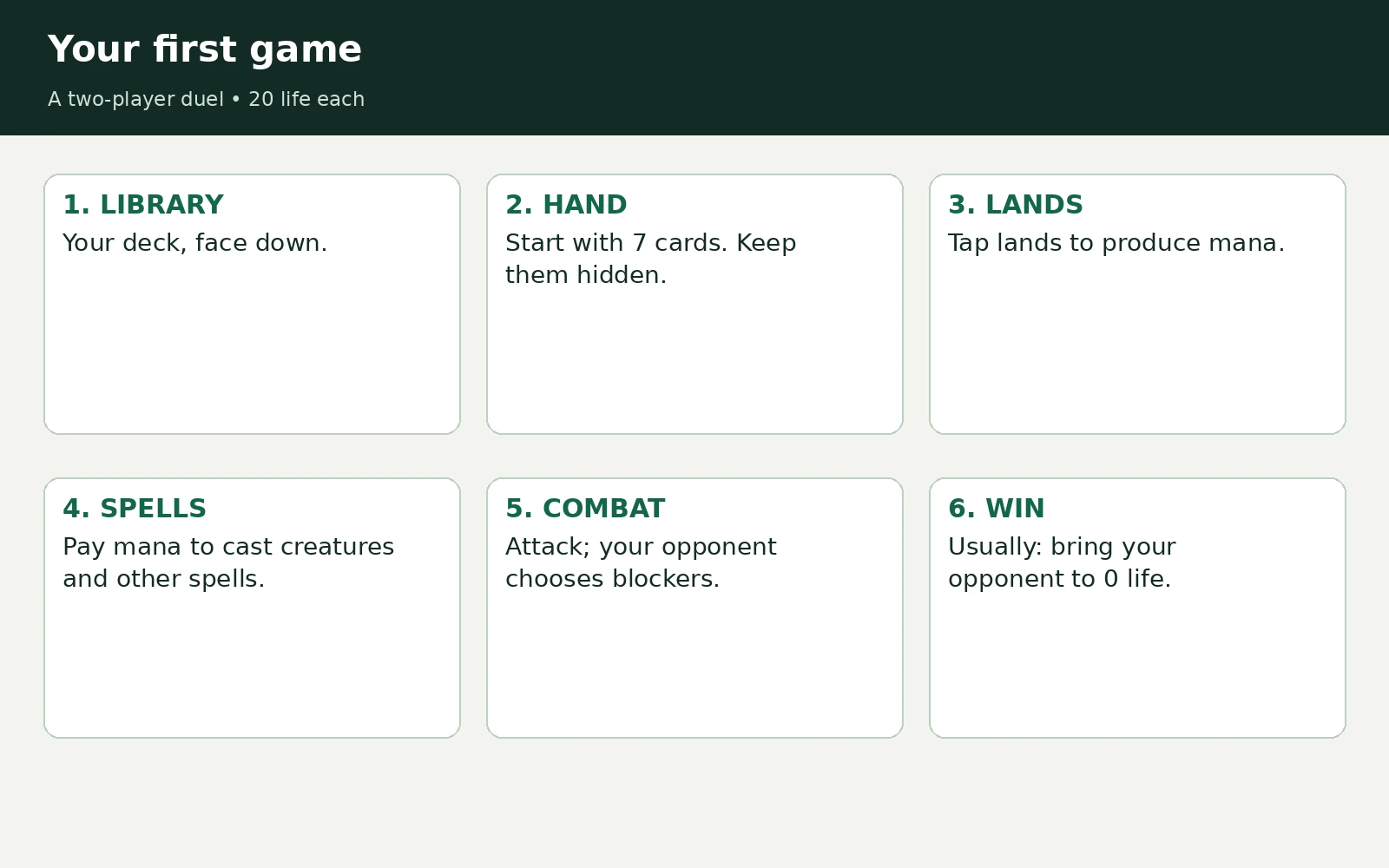
In a typical two-player game, you start at 20 life. You usually win by reducing your opponent to zero. Lands produce mana, the resource used to pay for spells. Creatures stay on the battlefield and can attack or block. Every card except a land is a spell while being cast; some resolve onto the battlefield, while others go to the graveyard.
The game casts you as a powerful mage who can travel between worlds. You do not need to know that story or role-play to enjoy it. Unlike games with one shared deck, each player normally supplies their own.
2. Why the Ninja Turtles are in Magic
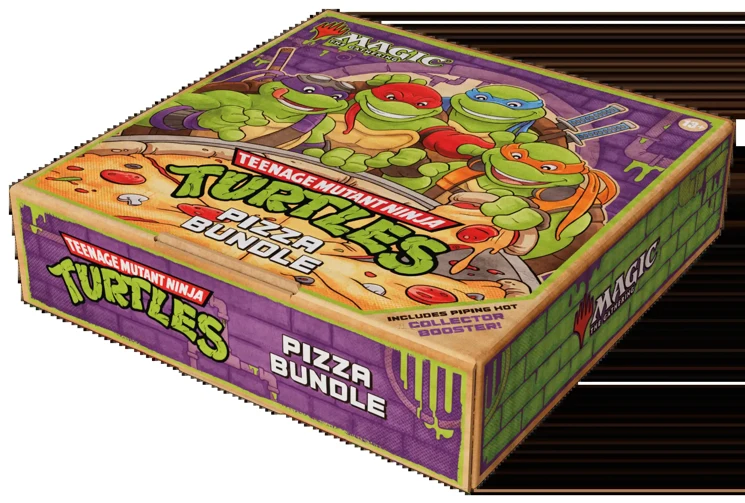
Magic: The Gathering | Teenage Mutant Ninja Turtles is an official Universes Beyond crossover. That product line brings other franchises into Magic’s rules. This is not a separate card game: you can combine these cards with other Magic sets when your format allows it. The tabletop release was March 6, 2026; Pizza Bundle followed on March 27. The set reached MTG Arena on March 3.
The collection draws on several generations of TMNT rather than one continuity. The four Turtles share the cards with Splinter, April, Casey Jones, Shredder, Krang, Bebop, Rocksteady, and other mutants, with plenty of New York references.
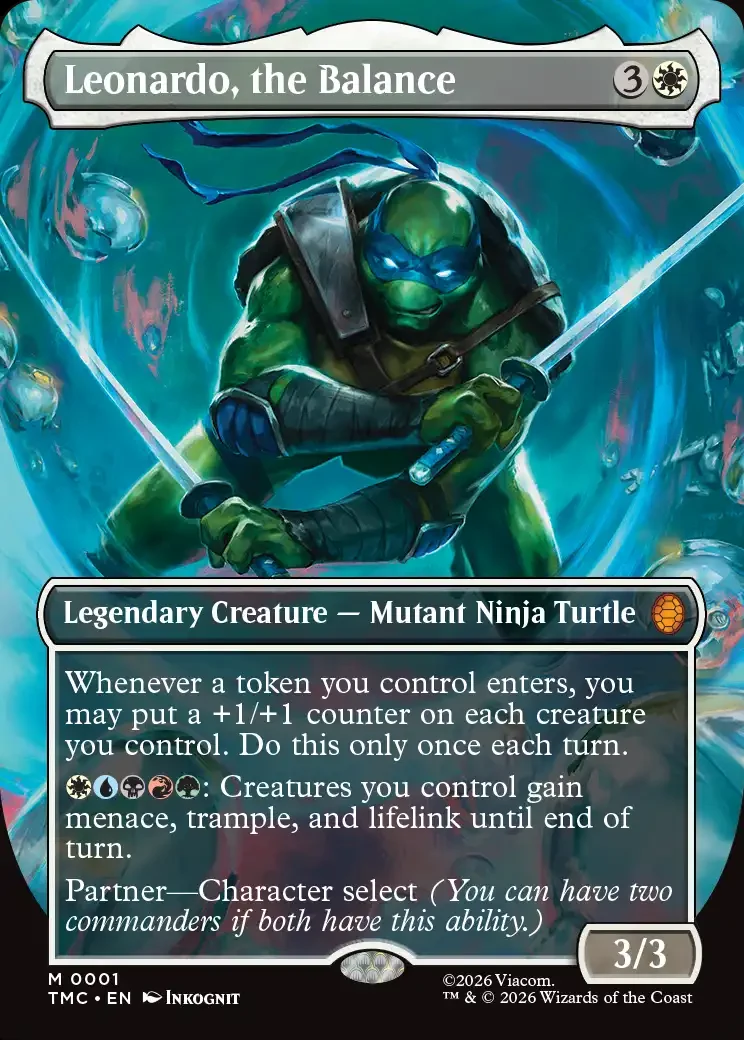
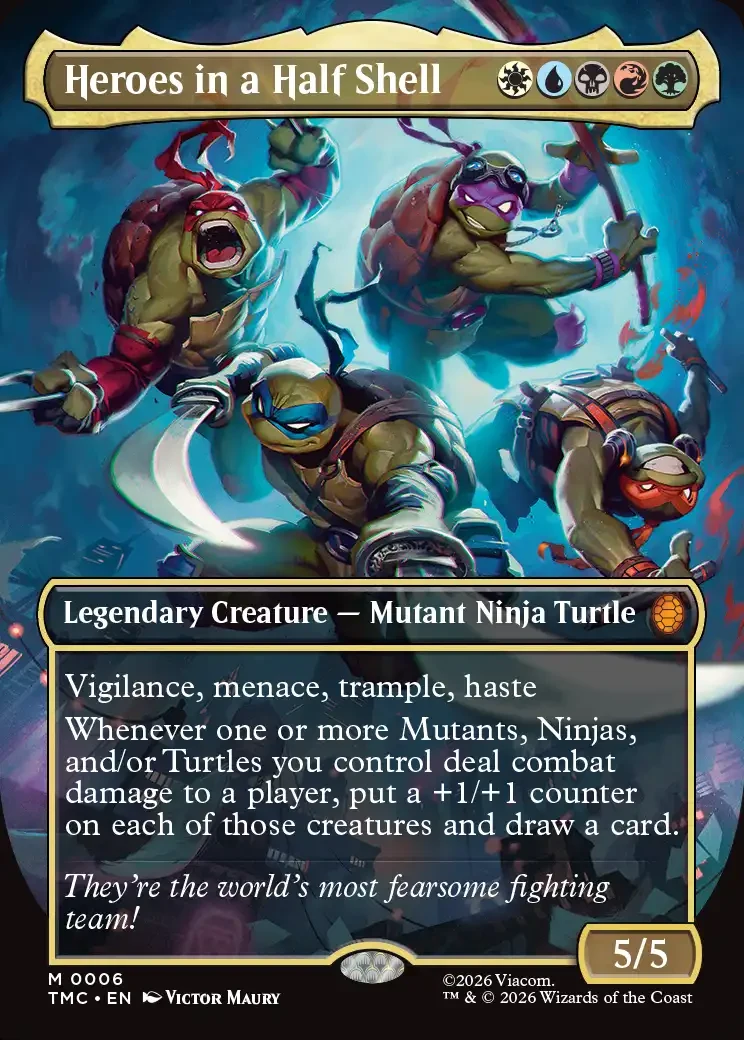
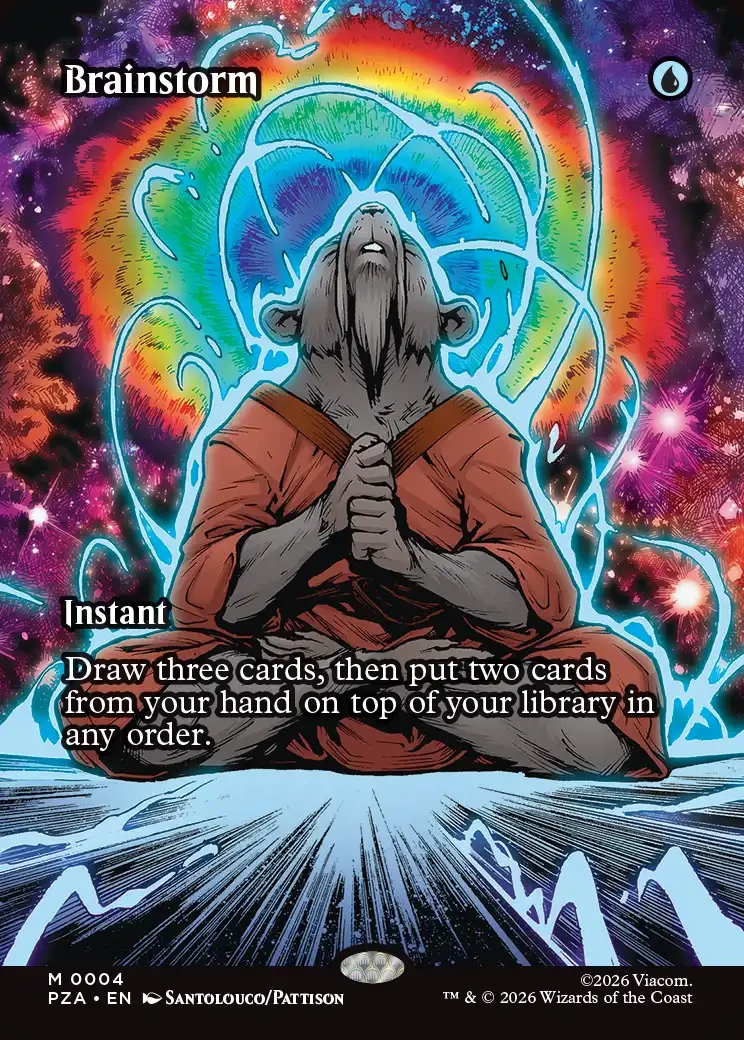
The Commander deck especially celebrates the video games: Electric Seaweed recalls the NES underwater hazard, while pirate Bebop and Rocksteady reference Turtles in Time. PZA cards put TMNT source artwork on returning Magic cards. The Headliner treatments feature Kevin Eastman artwork. Explore more of TMNT’s video game history.
Read Wizards’ account of the video game-inspired deck
3. How to read a real card
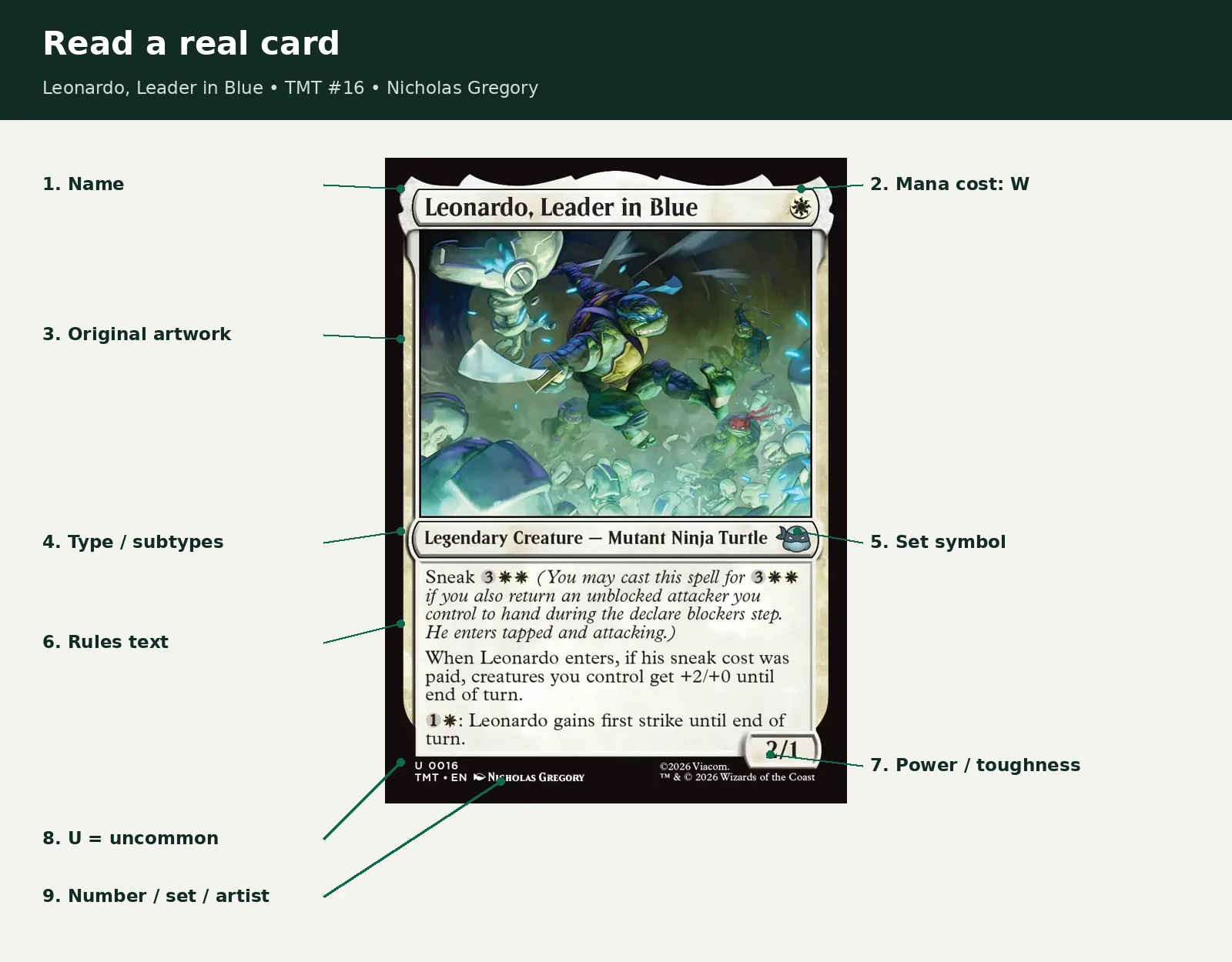
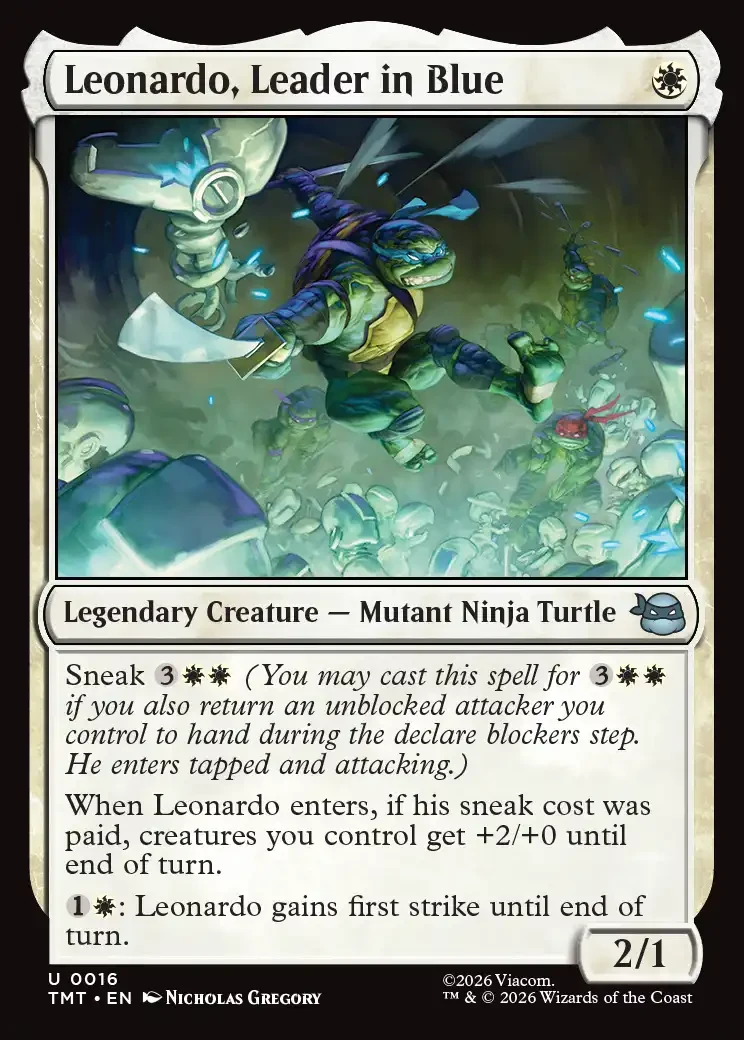
Our example is Leonardo, Leader in Blue, TMT #16. It costs one white mana, is a legendary creature, and has 2 power and 1 toughness. Names stay in their official English form throughout this guide.
| Element | How to read it |
|---|---|
| Name | Identifies the card. One character can have multiple cards with different subtitles. |
| Mana cost and colors | Top right. This guide abbreviates white W, blue U, black B, red R, and green G. |
| Artwork | Identifies the printing without changing its rules. |
| Type line | Legendary is a supertype; Creature is the card type; Mutant Ninja Turtle are subtypes. |
| Rules text | Sneak, an enters ability, and an activated ability are separate instructions. |
| 2/1 | Power: combat damage it deals. Toughness: normally how much damage destroys it. |
| Set symbol and rarity | The mask identifies the set. U beside the number means uncommon; C common, R rare, M mythic rare. |
| Bottom line | 0016 is the collector number; TMT the set; EN the language; Nicholas Gregory the illustrator. |
| Flavor and treatments | This card has no flavor text. Storytelling italics on other cards do not give rules instructions; parenthetical reminder text explains rules. A digital image alone does not identify a physical foil finish. |
Borderless and extended-art frames can change the layout; locate the name, cost, type, and rules text. Double-faced cards have another face to check. Split cards contain two spells; Double Jump // Flying Kick is a TMC example. Class enchantments divide their abilities into levels. Check the linked card’s current Oracle text when a printing is unclear.
4. The five colors of Magic
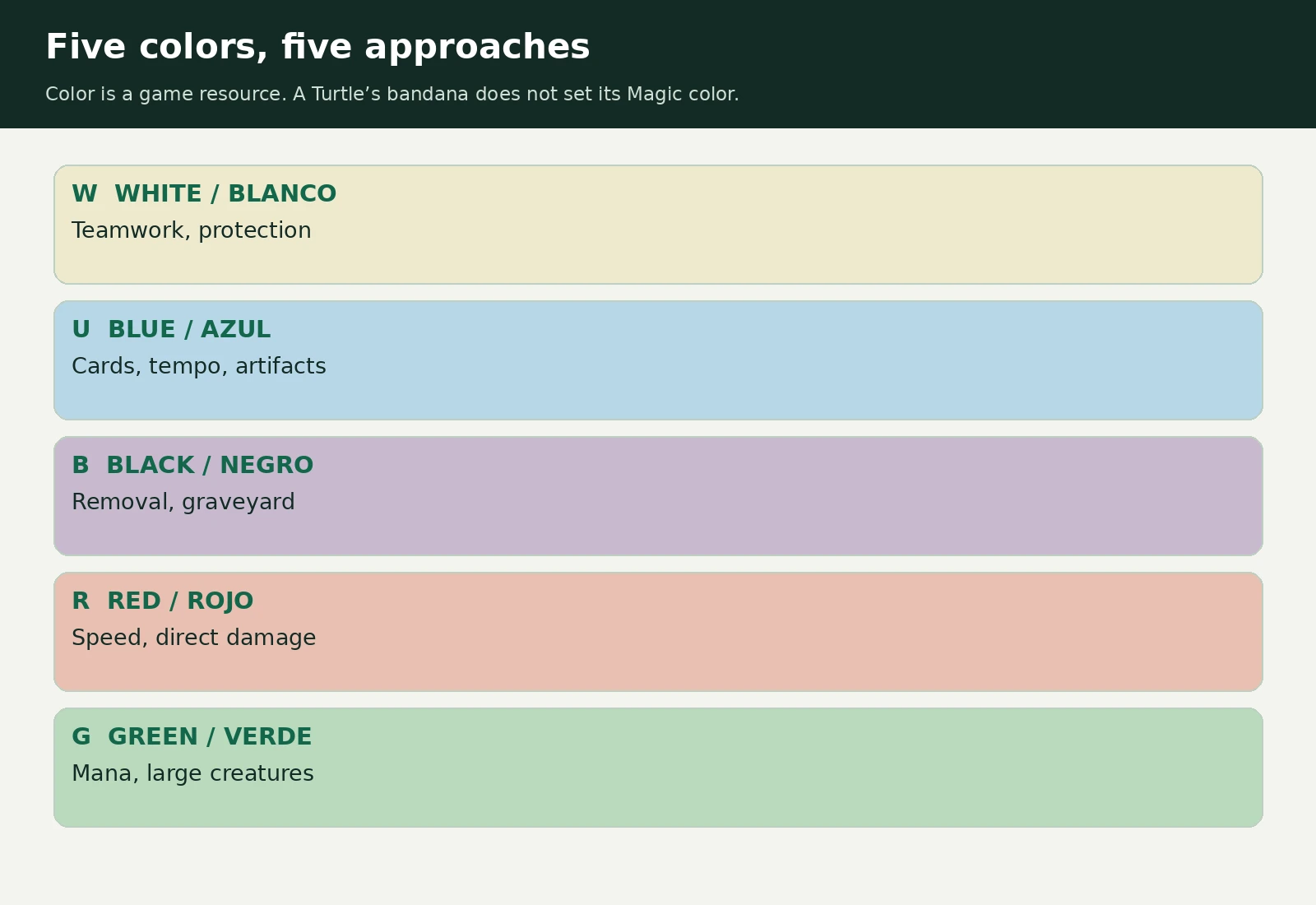
Colors determine your mana needs and the tools your deck tends to use. A Turtle’s bandana does not determine its Magic color: Leonardo can be white despite wearing blue.
| Color | Strengths and appeal | Typical limitation | TMNT example |
|---|---|---|---|
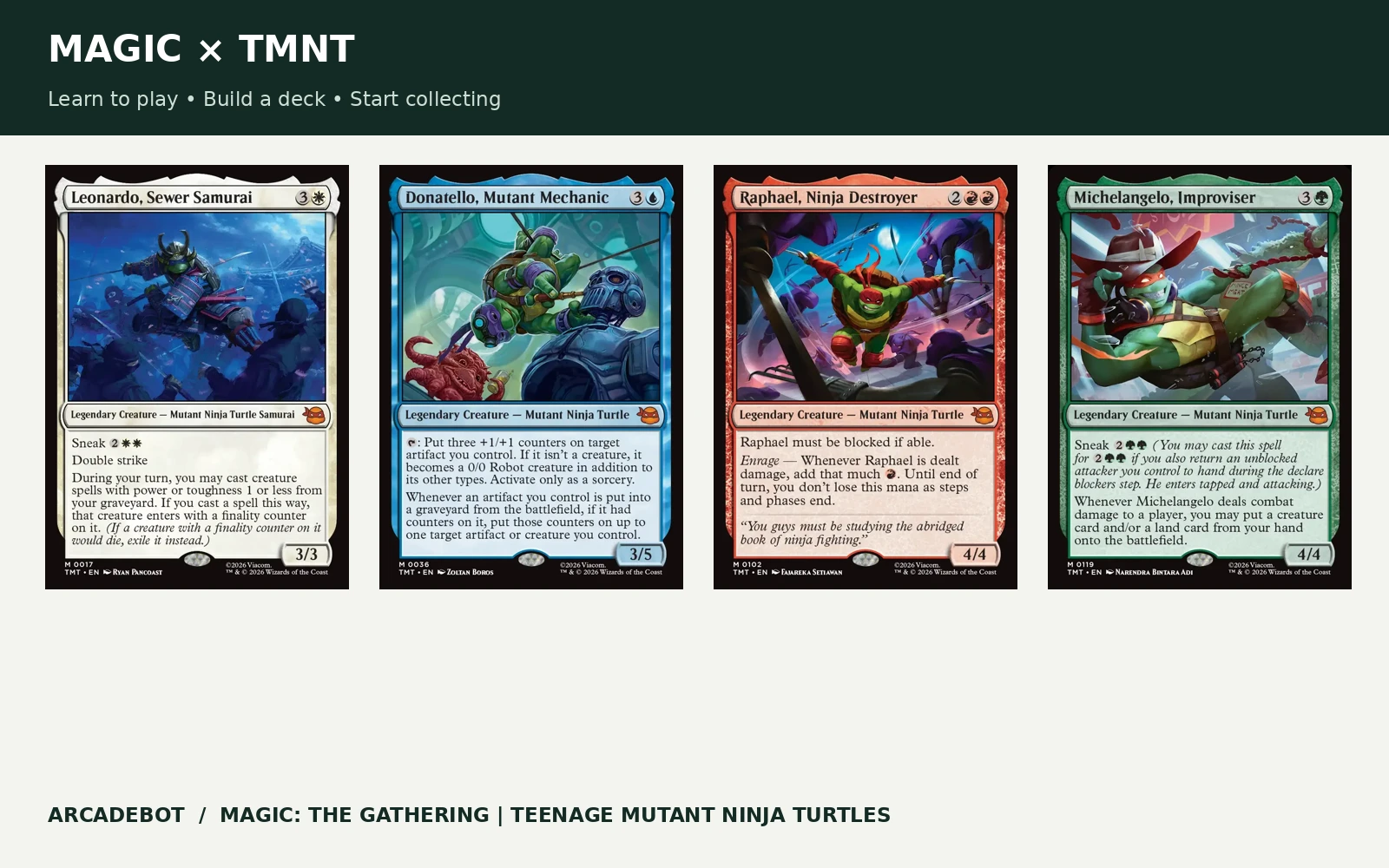
| White ☀ | Protection, teamwork, broad answers. For players who like a coordinated board. | May need help sustaining resources. | Leonardo, Leader in Blue |
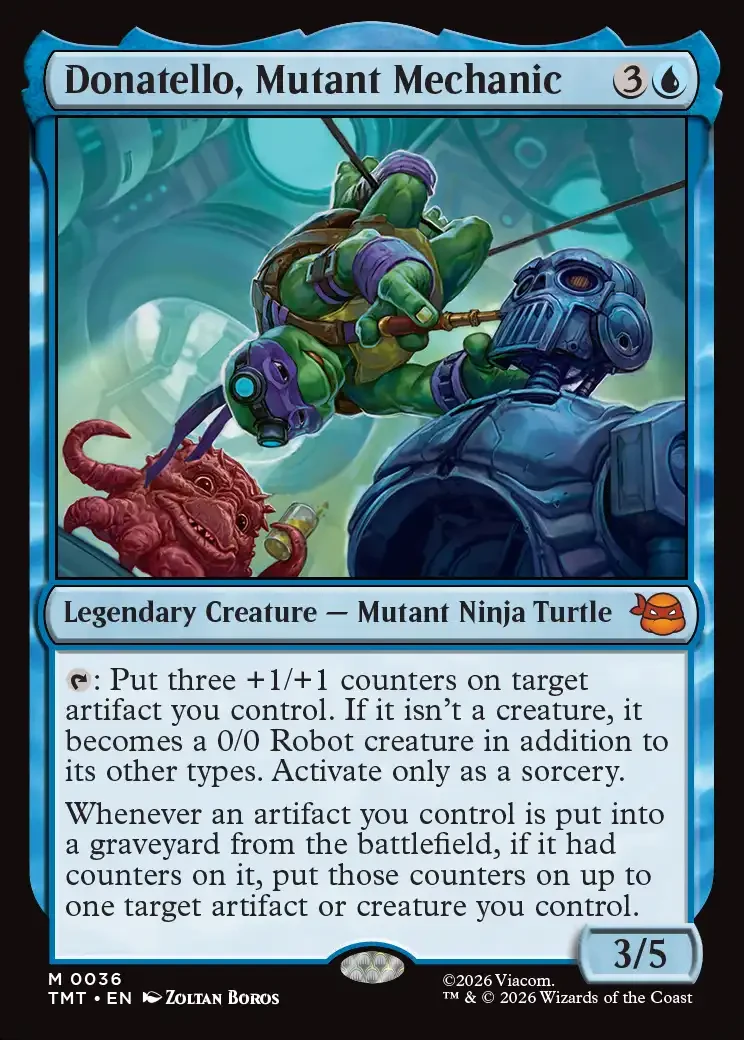
| Blue 💧 | Drawing cards, timing, artifacts. For planners. | Permanent creature removal is often less direct. | Donatello, Mutant Mechanic |
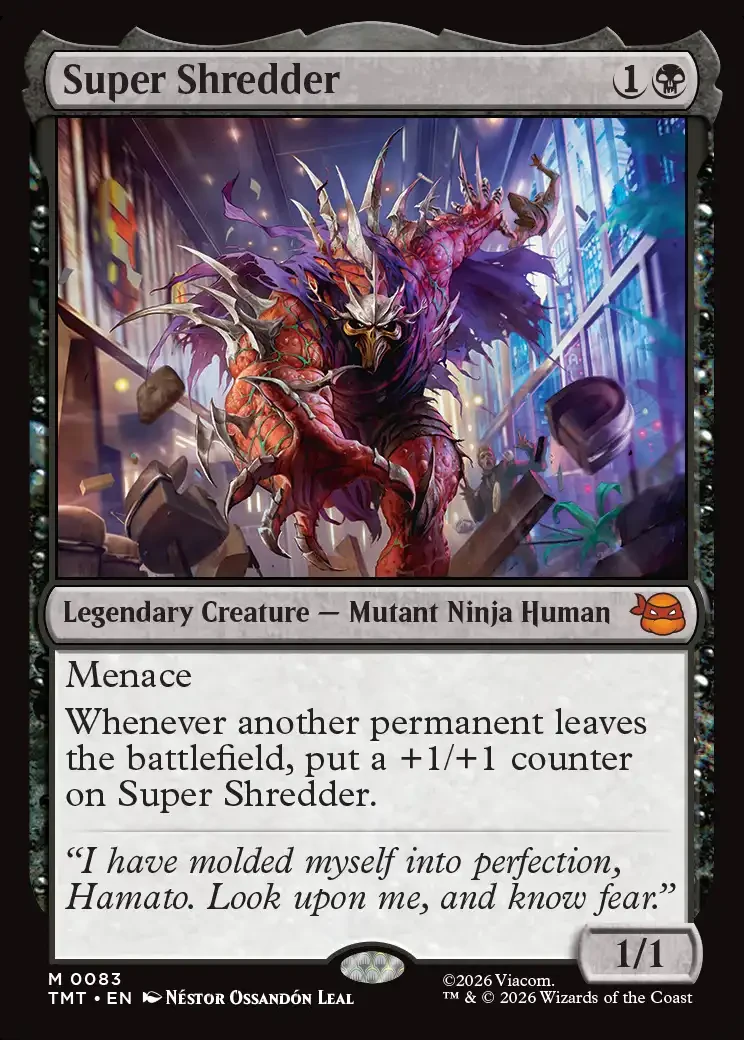
| Black 💀 | Removal, sacrifice, graveyard resources. For players comfortable trading resources. | Some effects cost life or permanents. | Super Shredder |
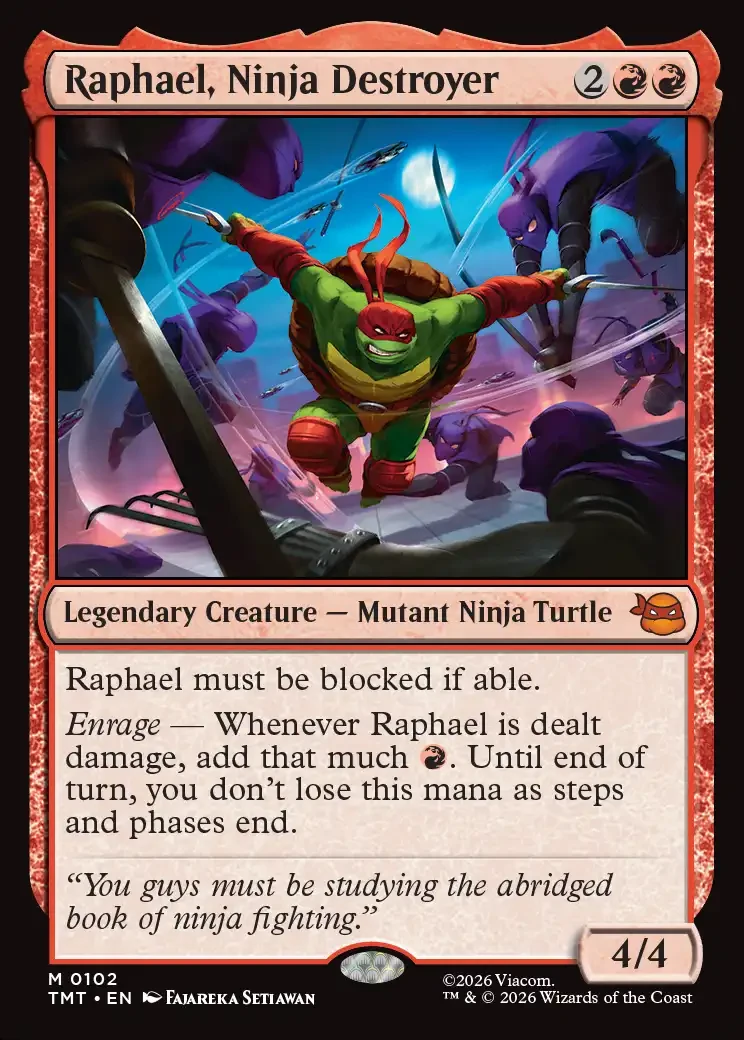
| Red 🔥 | Pressure, damage, speed. For proactive players. | Can run low on resources in longer games. | Raphael, Ninja Destroyer |
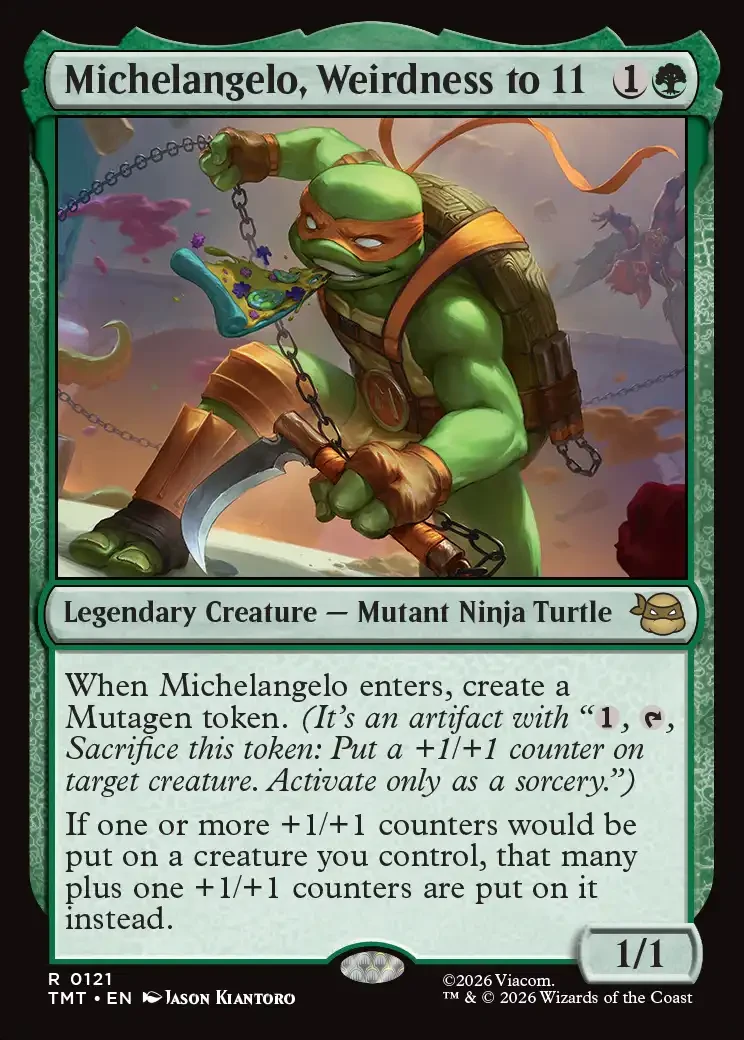
| Green 🌳 | Mana, larger creatures, counters. For players who enjoy building a board. | Often relies on creatures for interaction. | Michelangelo, Weirdness to 11 |
Multicolored cards have more than one color. Hybrid symbols such as G/W can be paid with either color. Colorless is not a sixth color. A number such as 3 is a generic cost, payable with any type of mana; ◇ specifically requires colorless mana. Lands are normally colorless even when they produce colored mana.
5. Card types: what each one does
| Type | When and why | Real example |
|---|---|---|
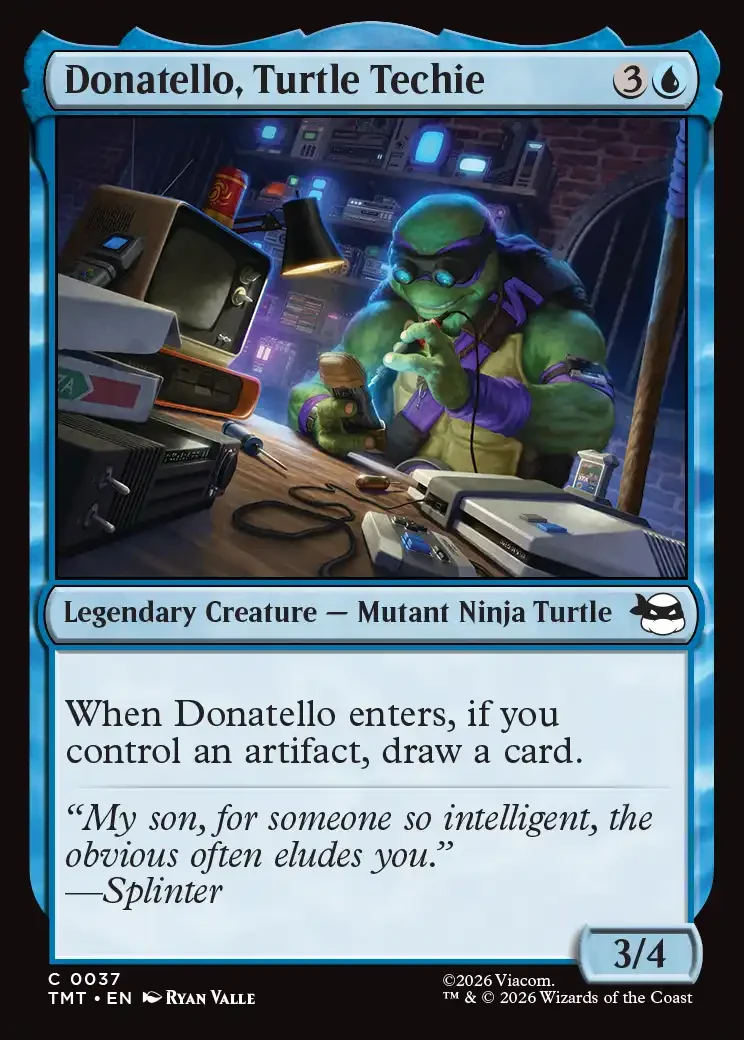
| Creature | Normally during your main phase with an empty stack. Can attack and block. | Donatello, Turtle Techie |
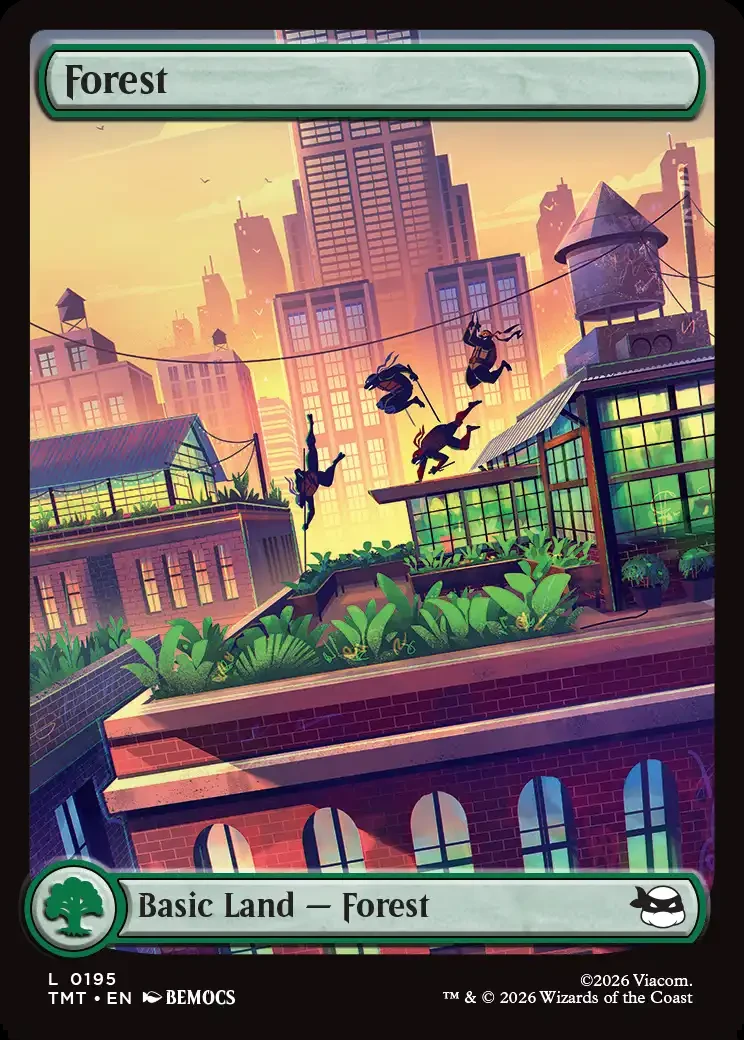
| Land | Normally one per turn, during your main phase with an empty stack. Not a spell. | Forest, TMT #195 |
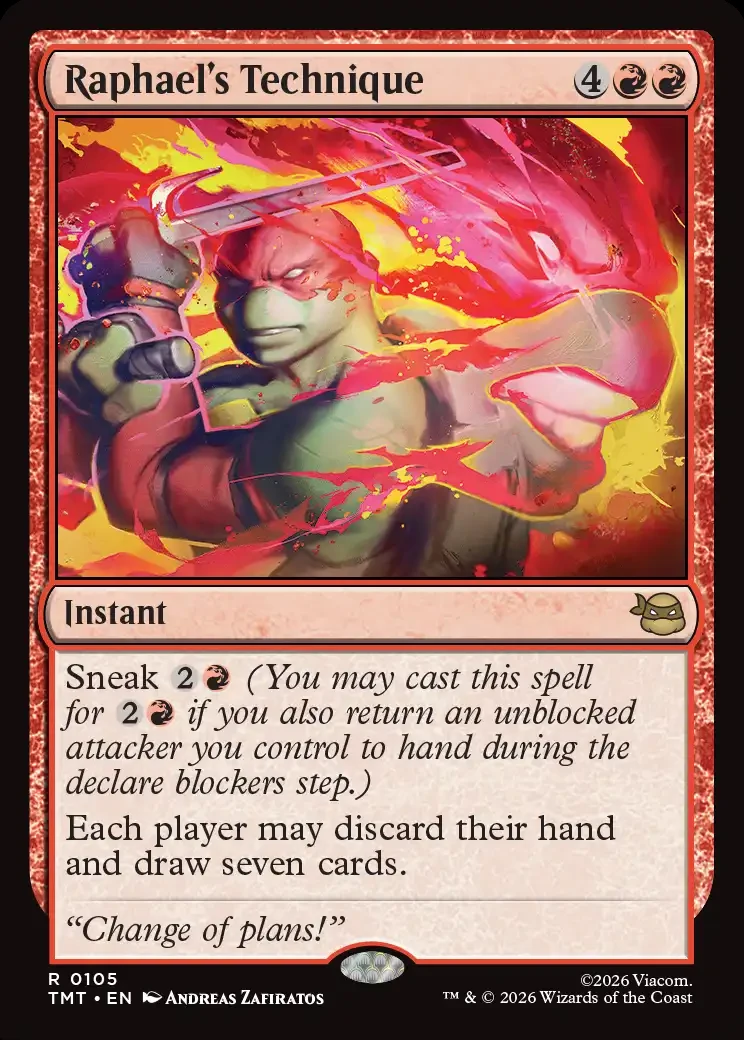
| Instant | Whenever you have priority, including opponents’ turns. Cannot interrupt paying a cost. | Raphael’s Technique |
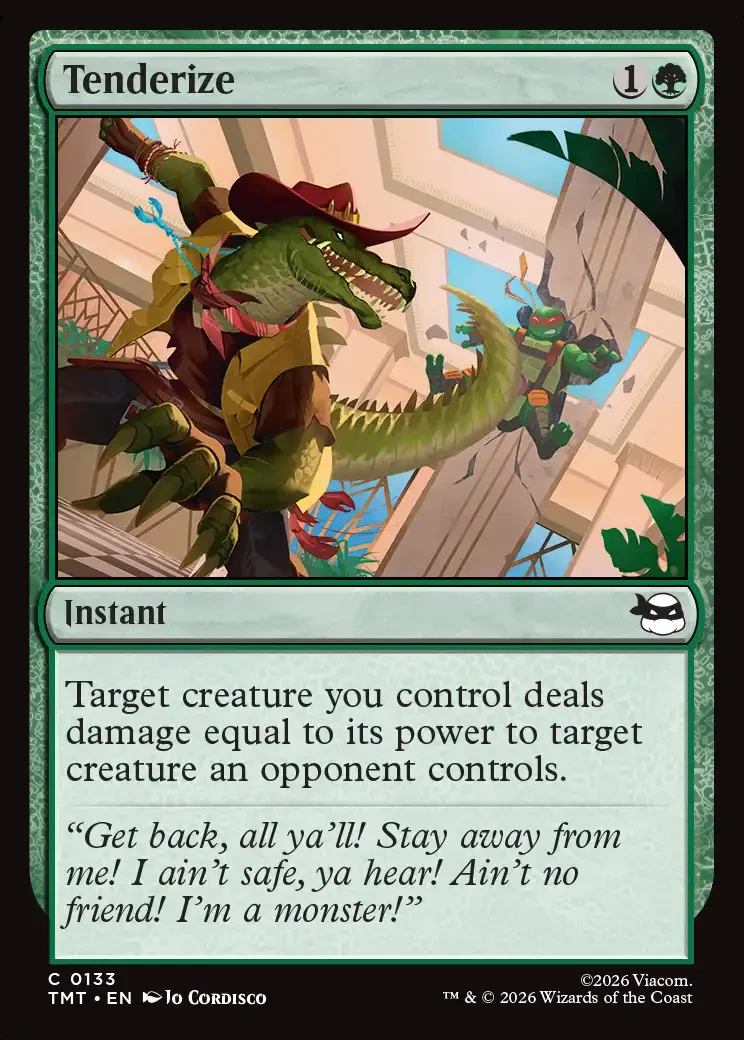
| Sorcery | Normally during your main phase with an empty stack. Resolves, then goes to the graveyard. | Tenderize |
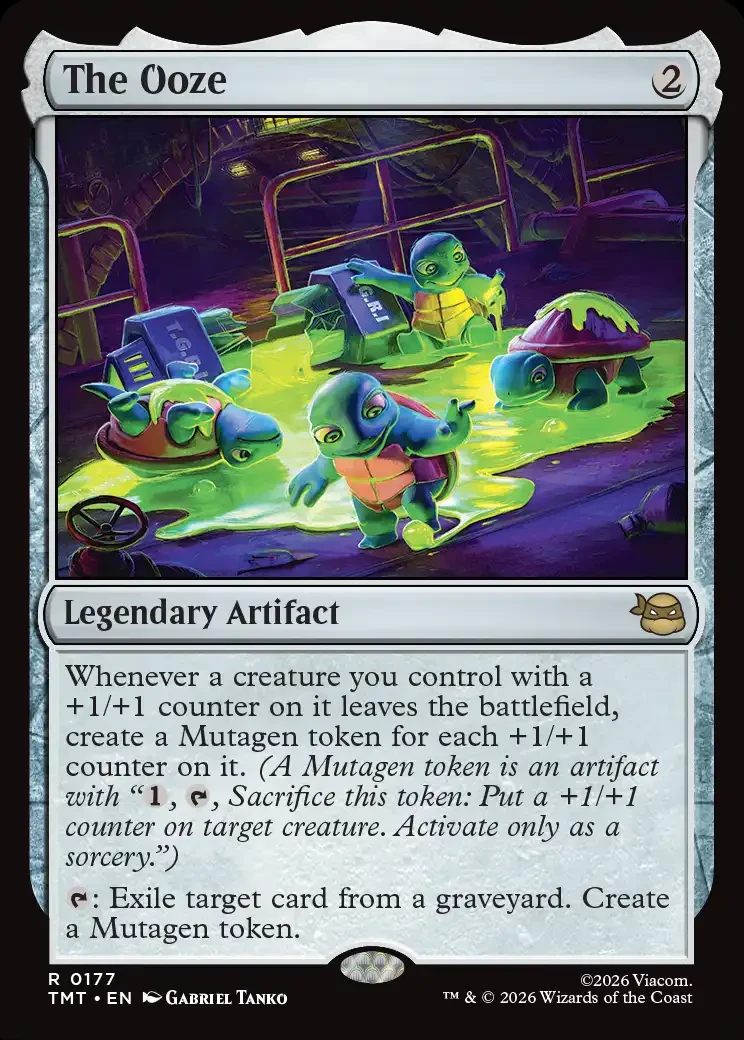
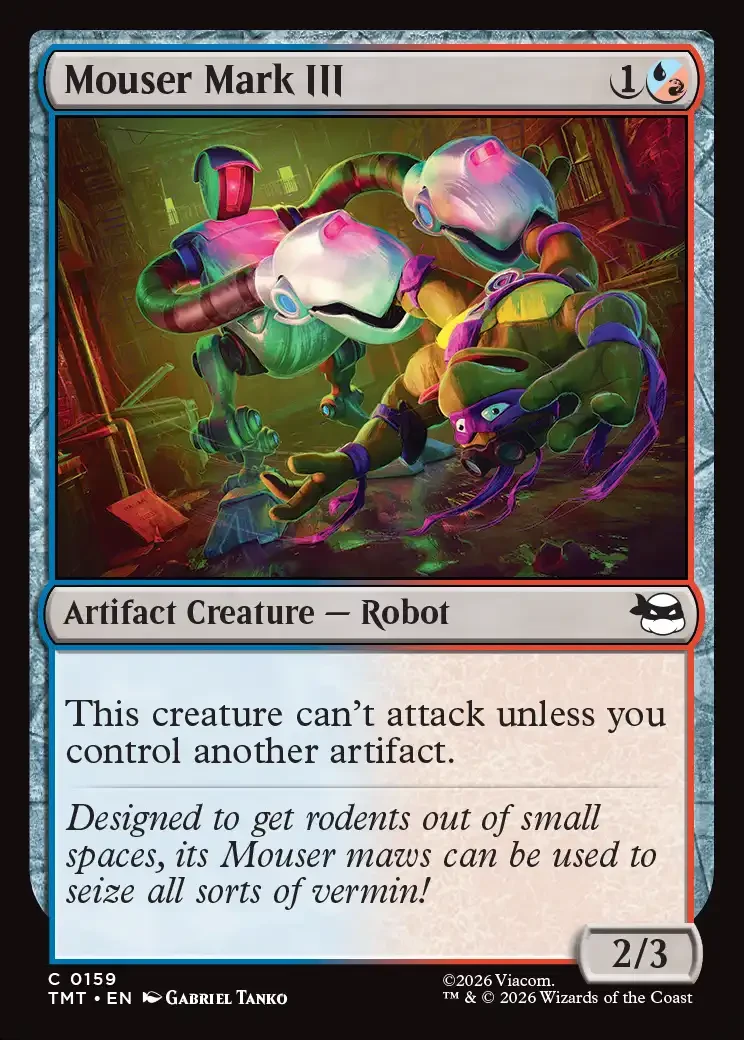
| Artifact | Normally cast with creature timing. Represents objects; some are also creatures. | The Ooze; Mouser Mark III is an artifact creature. |
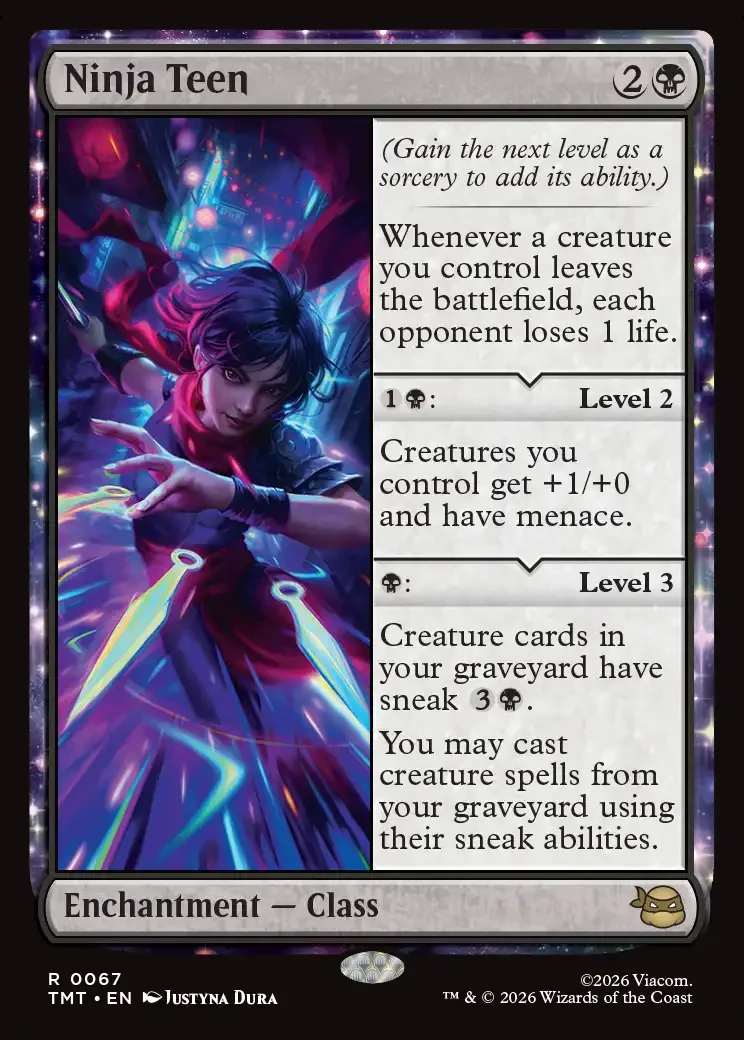
| Enchantment | Stays in play and affects the game. Auras attach; Classes gain levels. | Ninja Teen |
| Planeswalker | A general Magic type with loyalty and its own abilities. None in TMT’s #1–190 core. | Not used by this tutorial. |
| Battle | A general Magic type with defense and special rules. None in TMT’s #1–190 core. | Not needed for this guide’s sample games. |
A token is an object an effect creates, not a card you put in your starting deck. Mutagen and Food are artifact tokens, not lands. Equipment is an artifact subtype; equipping normally costs mana during your main phase. Vehicles are artifacts with crew instructions—read those before treating one as a creature. Legendary is not a rarity: if you control two legendary permanents with the same name, choose one and put the others into their owners’ graveyards.
6. How to play, step by step
Step 1. Gather your supplies
For this tutorial’s duel, you need two players and a deck of at least 60 cards each, normally with no more than four copies of any name except basic lands. Track your 20 life with paper, an app, or dice. A playmat protects cards but is optional. Dice can track counters too: keep lasting +1/+1 counters separate from temporary marked damage.
Step 2. Set up your zones
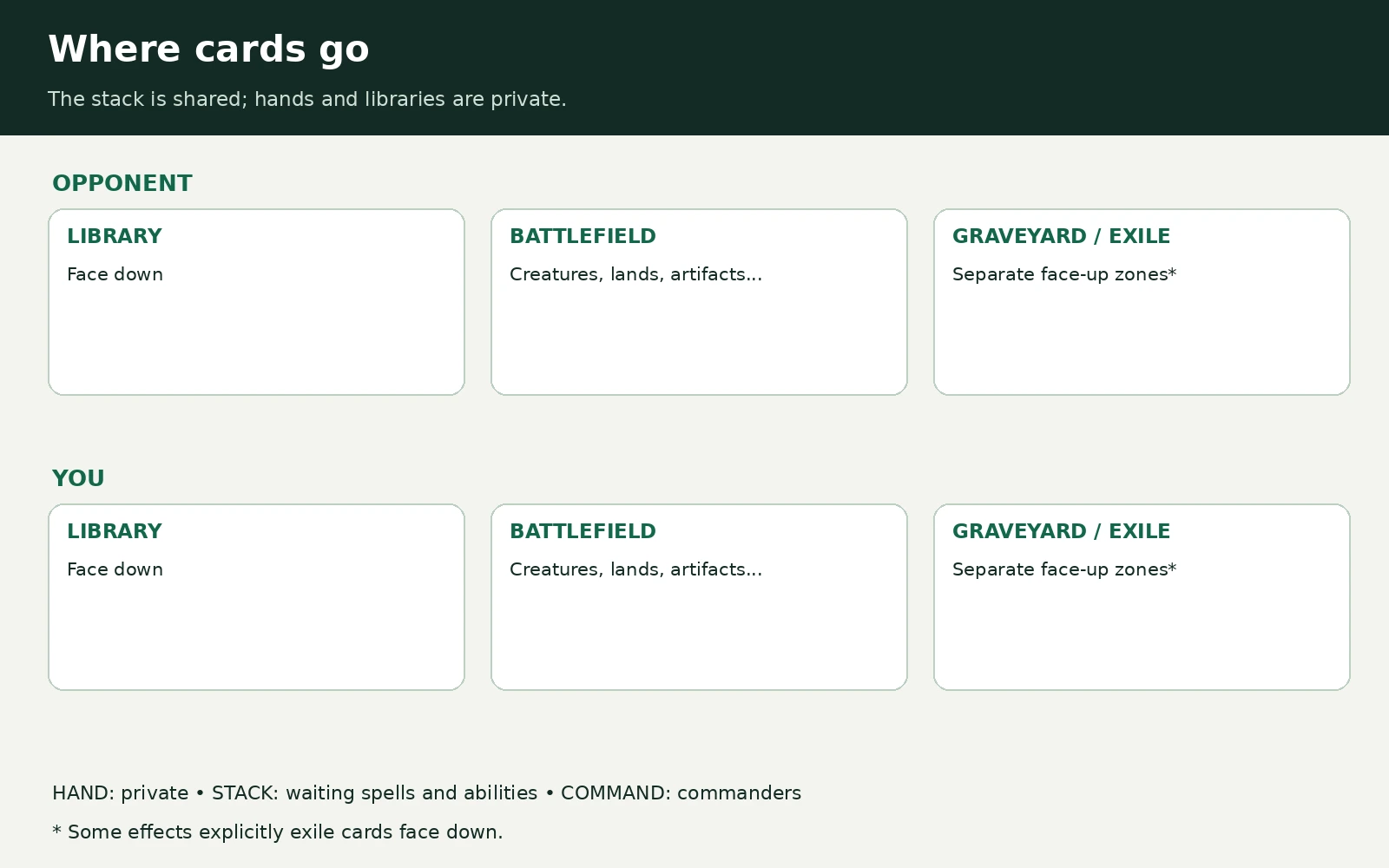
Library: your face-down deck. Hand: hidden cards you can play. Battlefield: permanents in play. Graveyard: face-up discard, open for inspection. Exile: a separate zone, usually face up. Stack: pending spells and abilities. Command zone: where commanders start in Commander. Keep graveyard and exile separate.
Step 3. Shuffle, draw seven, and decide whether to keep
Shuffle so the card order is unknown. Randomly decide who chooses the starting player. Each player draws seven. To mulligan, shuffle your entire hand back and draw seven again; when you keep, put one card on the bottom for each mulligan taken. The first mulligan already costs a card in a duel. Multiplayer gives you one free mulligan. Look for lands and early plays; three lands is often a comfortable starting point, depending on the deck.
The starting player in a duel skips their first draw step. In multiplayer Commander, everyone draws on their first turn. Turtle Team-Up uses its own cooperative setup booklet; do not replace that setup with these duel instructions.
Step 4. Play lands and pay mana
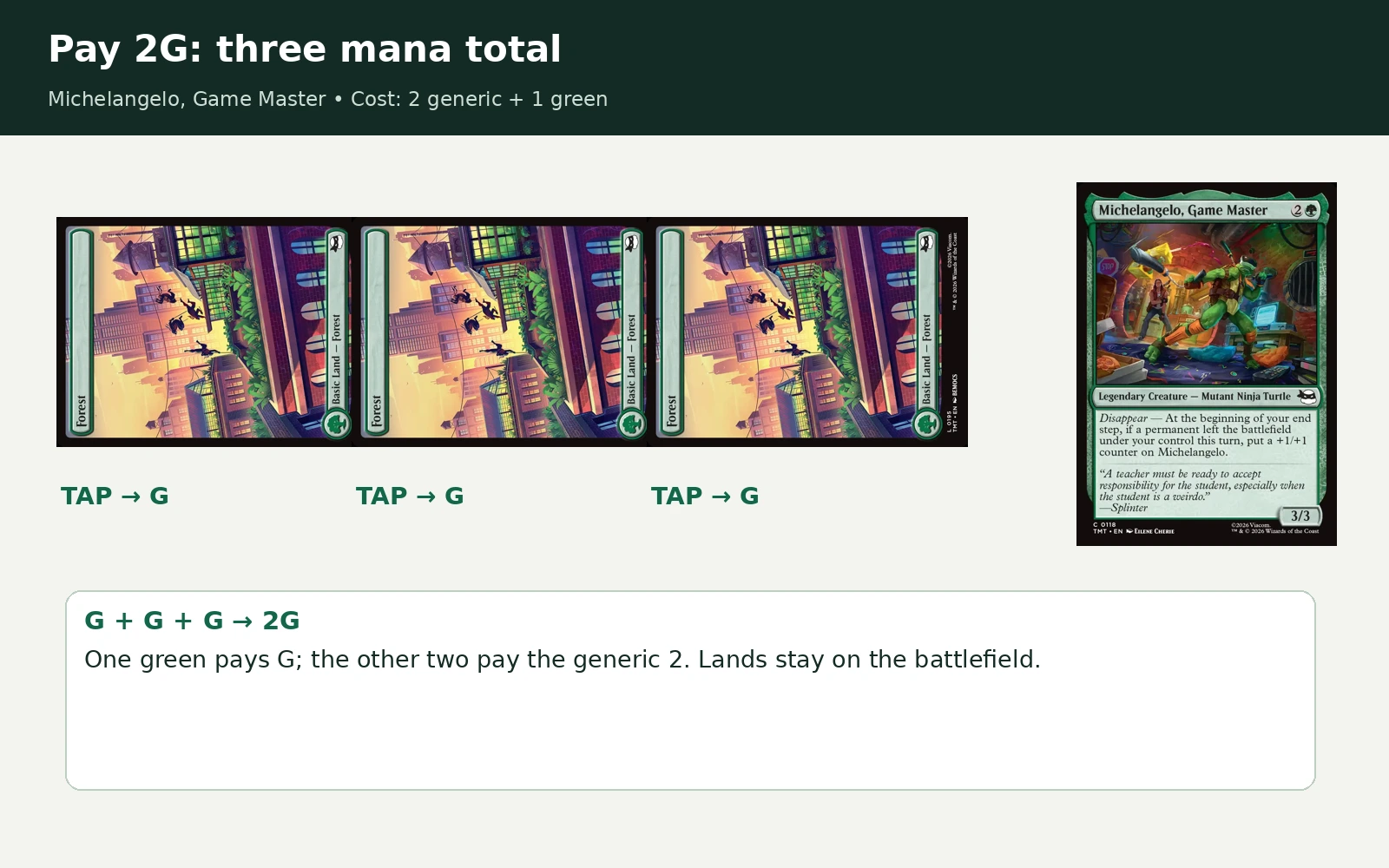
Play a land during your main phase with an empty stack. Playing it costs no mana. Tap a Forest to produce G. Michelangelo, Game Master costs 2G: three Forests can pay, with one green covering G and the other two covering the generic cost. Announce the spell, make required choices and select targets, then pay. Your lands stay tapped; the spell goes on the stack. When everyone passes without responding, it resolves.
Tapping means turning a card sideways. You do not discard or destroy a land to use it. Unspent mana normally empties at the end of each step and phase. Your lands remain and normally untap at the start of your next turn. A land that enters tapped cannot tap again for mana before it untaps.
Step 5. Follow the turn structure
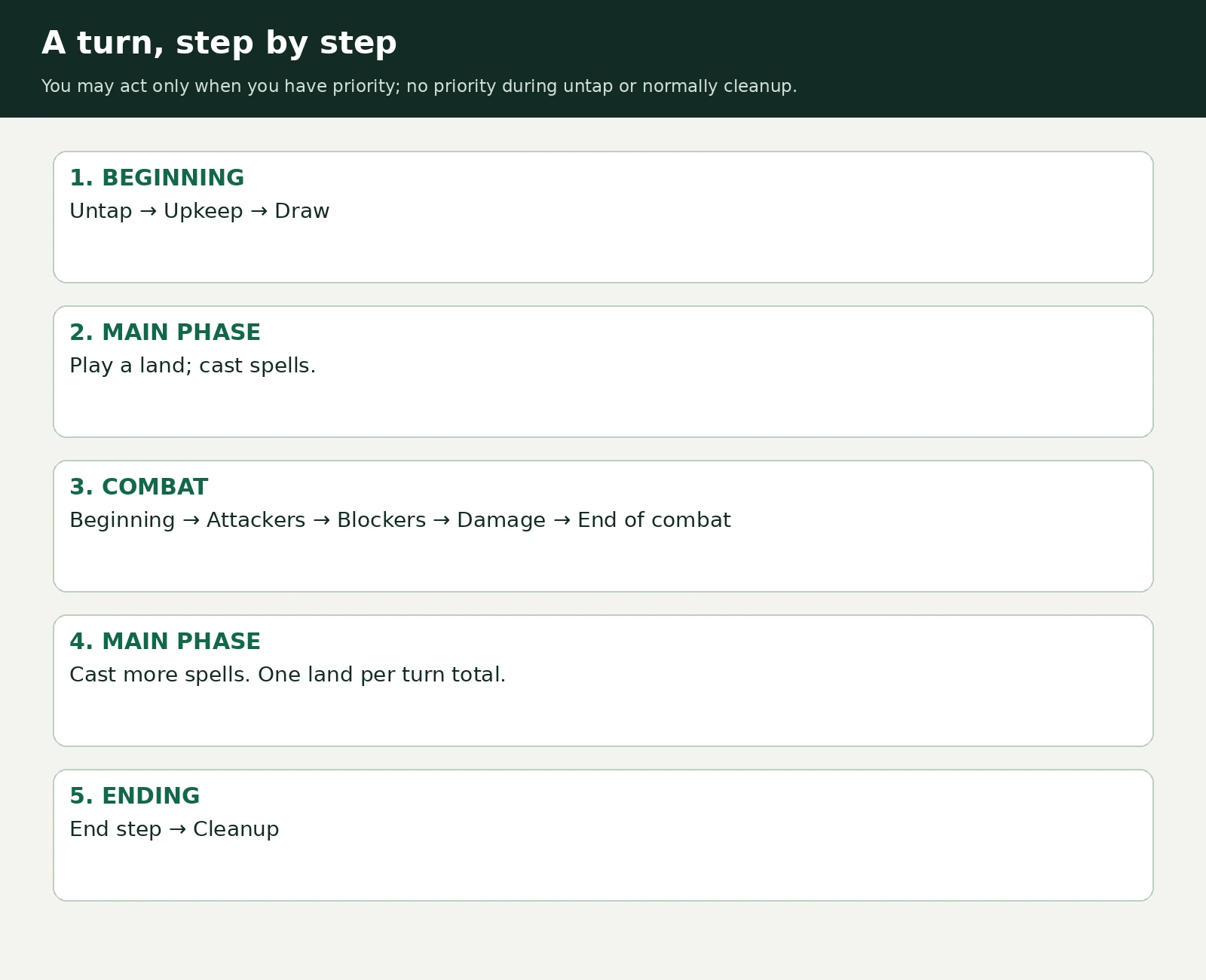
- Beginning: untap your permanents; upkeep abilities trigger; draw a card in the draw step. Nobody receives priority in the untap step.
- First main: play your land and cast creatures, artifacts, enchantments, or sorceries when you have priority and the stack is empty.
- Combat: beginning of combat → declare attackers → declare blockers → combat damage → end of combat. Players can respond in the appropriate windows between these actions.
- Second main: make more plays under the same rules. A second main phase does not grant a second land play.
- Ending: handle end-step triggers. During cleanup, discard to your maximum hand size, normally seven; marked damage clears and “until end of turn” effects end. Normally nobody receives priority during cleanup.
Step 6. Attack and block
You may attack with untapped creatures you have controlled continuously since your turn began, unless they have haste. That waiting period is called summoning sickness and also stops their abilities with the tap symbol. It does not stop blocking. Attacking normally taps a creature; vigilance prevents that tap. You choose which player, planeswalker, or battle to attack, not an enemy creature to hit. The defender chooses untapped blockers; blocking does not tap them.
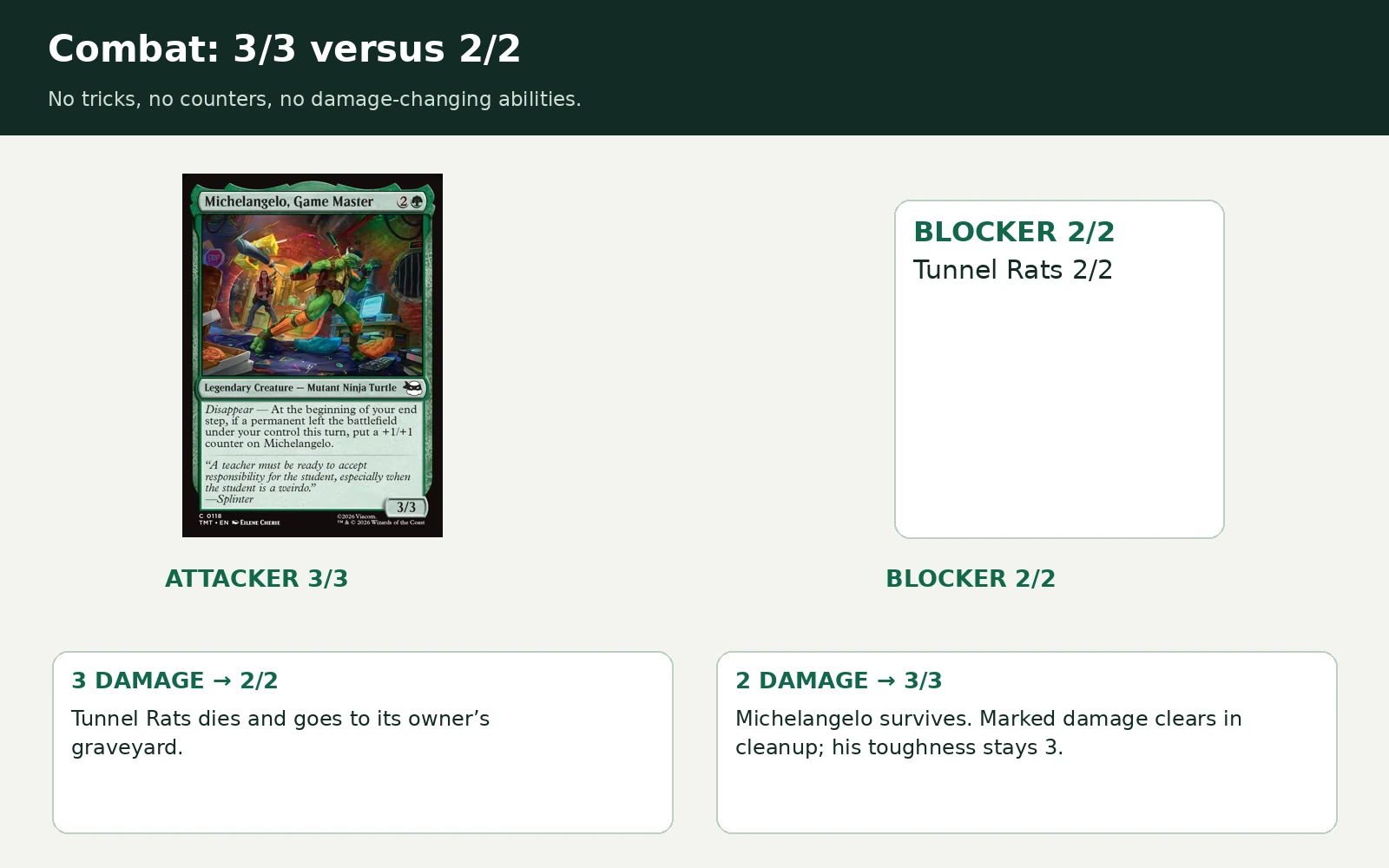
A 3/3 blocked by a 2/2 deals three damage and takes two simultaneously. The 2/2 dies; the 3/3 survives with two marked damage and still has 3 toughness. The damage clears in cleanup. The defending player loses no life here. A blocked attacker stays blocked even if its blocker disappears; without trample, it normally deals no damage to the player.
Multiple creatures may block one attacker. Under current rules, the attacking player divides that attacker’s damage freely among them; there is no required damage assignment order. First strike and double strike can create another damage step. Combat damage does not use the stack: cast combat tricks before damage happens.
Step 7. Respond and use abilities
Priority is your permission to act. When your opponent casts a spell, you can normally respond with an instant or ability before it resolves. The stack resolves last in, first out. After one object resolves, players get another opportunity to act. Mana abilities normally do not use the stack. Playing a land does not use it either.
| Ability | How to identify it | Example |
|---|---|---|
| Activated | Cost: effect. You choose to pay. | 1W: Leonardo gains first strike. |
| Triggered | Begins with when, whenever, or at. | Donatello, Turtle Techie draws on entering if you control an artifact; the condition is checked when triggering and resolving. |
| Static | Applies continuously while relevant. | Michelangelo, Weirdness to 11 adds an extra counter whenever you put +1/+1 counters on your creatures. |
The glossary covers key combat words. The next block explains this release’s signature mechanics.
TMNT mechanics to recognize
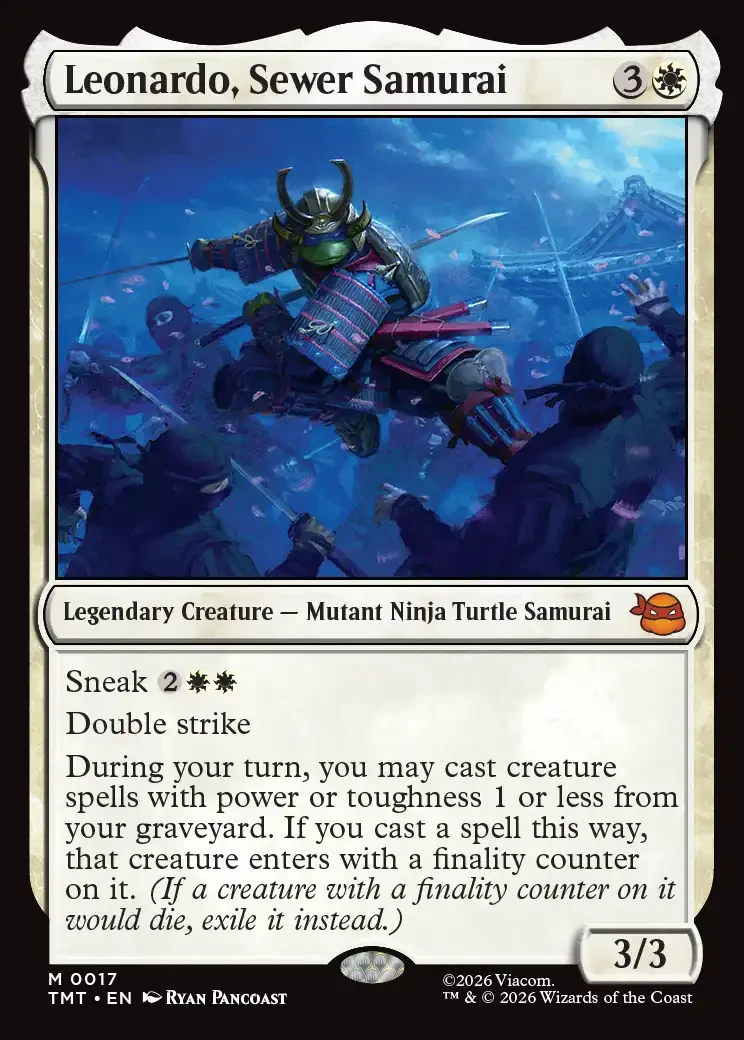
- Sneak: an alternative casting cost, not a ninjutsu activated ability. Use it only during your declare blockers step after blockers are declared. In addition to its listed mana cost, return an unblocked attacker you control to its owner’s hand as part of the cost. A creature enters tapped and attacking the same defender. The spell can still be countered. For example, return Featherbrained Filcher and pay 2WW to cast Leonardo, Sewer Samurai.
- Mutagen: an artifact token. Pay 1, tap and sacrifice it to put a +1/+1 counter on target creature, only as a sorcery. With Michelangelo, Weirdness to 11, that normally becomes two counters. You cannot save this activation for a surprise combat boost.
- Disappear: highlights abilities that care whether a permanent left the battlefield under your control that turn. Sacrificing a token or returning your creature to hand can qualify. Michelangelo, Game Master gets a counter at your end step if the condition was met.
- Alliance: highlights triggers when another creature you control enters. Creature tokens count. Each card supplies its own reward.
- Class: starts at level 1. Pay the next level’s cost as a sorcery and keep earlier abilities. Ninja Teen cannot skip level 2. Levels are not counters.
- Partner—Character select: allows two commanders if both have that exact variant. Combine their color identities; ordinary partner is not interchangeable. Leonardo, the Balance has a five-color identity because of symbols in his rules text, despite a white casting cost.
- Food: pay 2, tap and sacrifice the token to gain three life. It is not Mutagen. A finality counter instead exiles its permanent if it would go from the battlefield to the graveyard.
Official set mechanics explained
Step 8. Win the game
A player normally loses at zero or less life, when trying to draw from an empty library, or with ten poison counters. An empty library alone is not a loss. Commander also uses a loss condition of 21 combat damage from the same commander; noncombat damage does not count toward it. Specific cards can provide other win or loss conditions when their text says so. The last player remaining wins.
Step 9. A complete teaching game
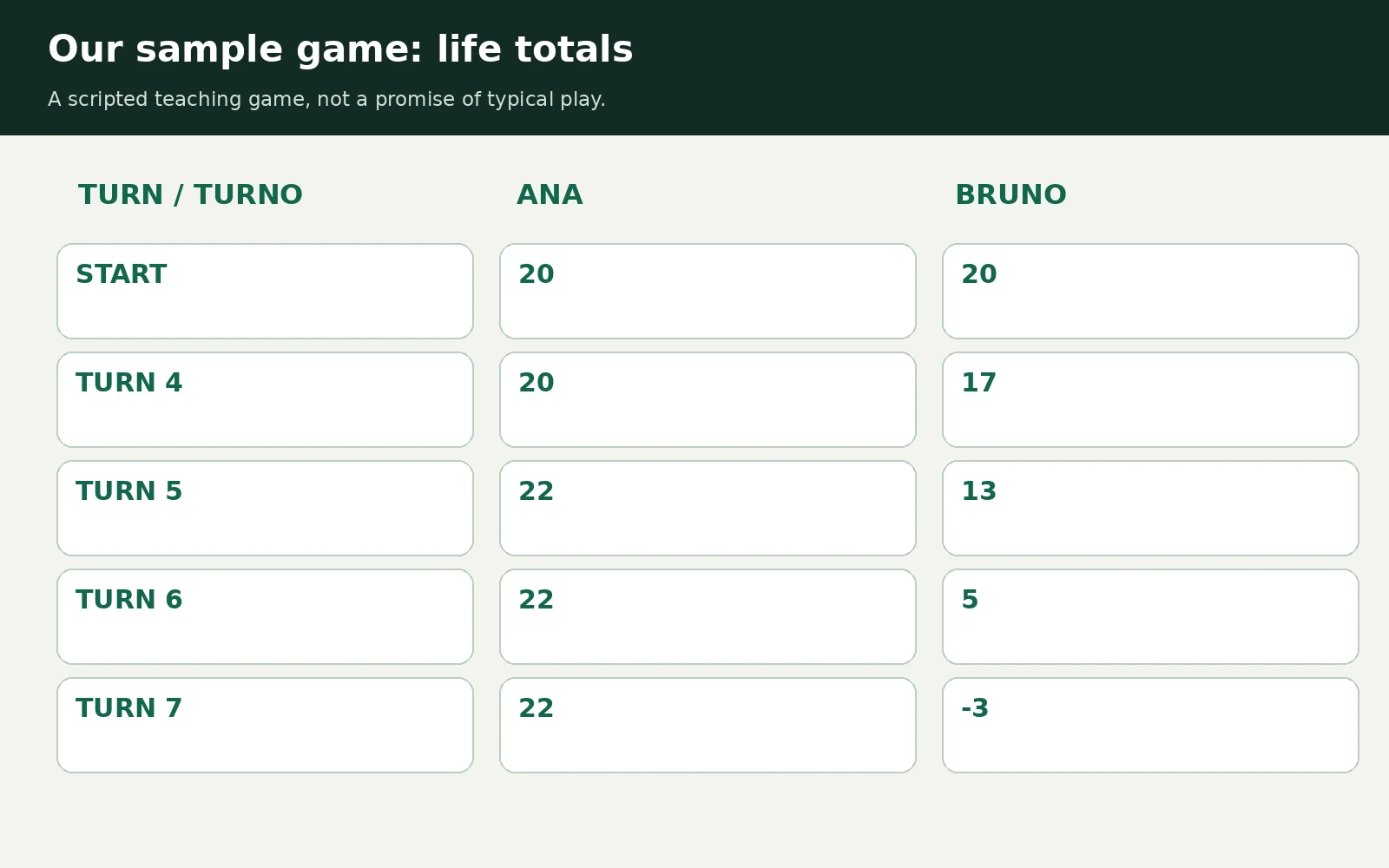
This scripted duel is designed to teach: both players have legal 60-card decks and draw lands during the turns shown. These are not recommended opening hands or an example of competitive play. There are no other effects or responses. Ana goes first; both players start at 20 life.
Ana’s seven: 3 Forest, Frog Butler, Michelangelo, Game Master, Tenderize, and Primordial Pachyderm. Bruno’s seven: 5 Swamp, Squirrelanoids, and Tunnel Rats. Ana draws a Forest on each of turns 2–7. Bruno draws a Swamp on every turn and plays one through his sixth turn. Both decks can contain other legal cards that they never reach.
| Turn | Plays and decisions | Ana / Bruno life |
|---|---|---|
| 1 | Ana plays Forest and passes, skipping her draw. Bruno draws, plays Swamp, and casts Squirrelanoids for B. | 20 / 20 |
| 2 | Ana draws, plays Forest, and pays 1G for Frog Butler. Bruno draws, plays Swamp, and pays 1B for Tunnel Rats. He does not attack. | 20 / 20 |
| 3 | Ana plays a third Forest and pays 2G for Michelangelo, Game Master. Neither player attacks. Bruno plays Swamp. | 20 / 20 |
| 4 | Ana plays Forest and pays 1G for Tenderize: Michelangelo deals 3 to Squirrelanoids, which dies without dealing damage back. Ana attacks with Michelangelo and Frog Butler. Bruno blocks Frog Butler with Tunnel Rats: both die because of damage and deathtouch. Michelangelo deals 3 to Bruno. Disappear adds a counter at end step, making him 4/4. Bruno plays a land and passes. | 20 / 17 |
| 5 | Ana plays Forest and pays 3G for Primordial Pachyderm, gaining 2 life. Only Michelangelo can attack; he deals 4. Bruno plays a land and passes. | 22 / 13 |
| 6 | Ana plays Forest and attacks with both 4/4s. Bruno takes 8, then plays a land and passes on his turn. | 22 / 5 |
| 7 | Both creatures attack again. Eight damage brings Bruno to −3; he loses immediately. | 22 / −3 |
7. Build your first deck
Start with one plan and one or two colors. In a casual 60-card deck, 24 lands is a starting guideline, not a rule. Adjust for costs and mana sources. A 40-card Limited deck commonly starts at 17 lands; roughly 36–38 is an initial Commander range that depends on the strategy.
Your mana curve is the spread of card costs. Too many five- and six-mana cards leave you waiting through early turns. Include two- and three-mana plays, interaction, and a way to recover resources. A synergy is simply cards helping one another: Mutagen production supports creatures that reward counters.
An original practice list: 60-card green TMNT
This is an ArcadeBot teaching deck, not a tournament list or official product. Every card has a TMT printing. Use whichever TMT Forest artwork you prefer. Card names, mana costs, totals, and copy limits were checked.
| Copies | Card |
|---|---|
| 24 | Forest |
| 4 | Frog Butler |
| 4 | Michelangelo, Game Master |
| 4 | Michelangelo, Mutant BFF |
| 4 | Mona Lisa, Science Geek |
| 4 | Primordial Pachyderm |
| 4 | Ragamuffin Raptor |
| 4 | Tenderize |
| 4 | Transdimensional Bovine |
| 4 | Michelangelo’s Technique |
Develop mana with Frog Butler and Mona Lisa. Michelangelo, Game Master is a three-mana 3/3; effects that make permanents leave can grow him. Use Tenderize when your creature has enough power and an opposing creature matters. Primordial Pachyderm brings trample and two life; Ragamuffin Raptor recovers a creature; Michelangelo’s Technique can put threats into play. You do not have to use sneak to cast it.
To improve the list, play it before buying premium treatments. Trim expensive cards if they clog your hand. Add threats if you run out of creatures; revisit interaction if you cannot answer opposing plays. The legend rule limits same-name legendary permanents in play, even though this deck may contain four copies.
A complete official alternative: Turtle Power!
For Commander, Turtle Power! supplies a ready-to-play 100-card deck using TMC and TMT cards. Keeping the entire five-color deck requires an appropriate commander configuration. Switching to Donatello and Splinter, for example, means removing cards outside their combined color identity.
8. Formats and legality: check the set code
Your format sets the allowed cards and deckbuilding rules. The printed set code matters: opening a PZA card in a TMT booster does not automatically make it Standard legal. Rotation and bans can change legality; check the individual card before an event.
| Format | Basic rules | Which cards qualify |
|---|---|---|
| Standard | 60+; 20 life | TMT during its Standard legality window. TMC/PZA only when the name is otherwise legal. |
| Pioneer / Modern | 60+; 20 life | TMT; TMC/PZA reprints depend on name legality and bans. |
| Commander | Exactly 100 including commander(s); 40 life; usually 4 players | TMT, TMC, and PZA subject to color identity, singleton, and bans. Normally only legendary creatures can command. |
| Legacy / Vintage | 60+; 20 life | All three codes subject to bans or restrictions. Sol Ring is banned in Legacy and restricted to one in Vintage. |
| Limited: Sealed | 40+; 20 life | Build from opened packs plus basic lands, normally six Play Boosters. The usual four-copy cap does not apply to your opened pool. |
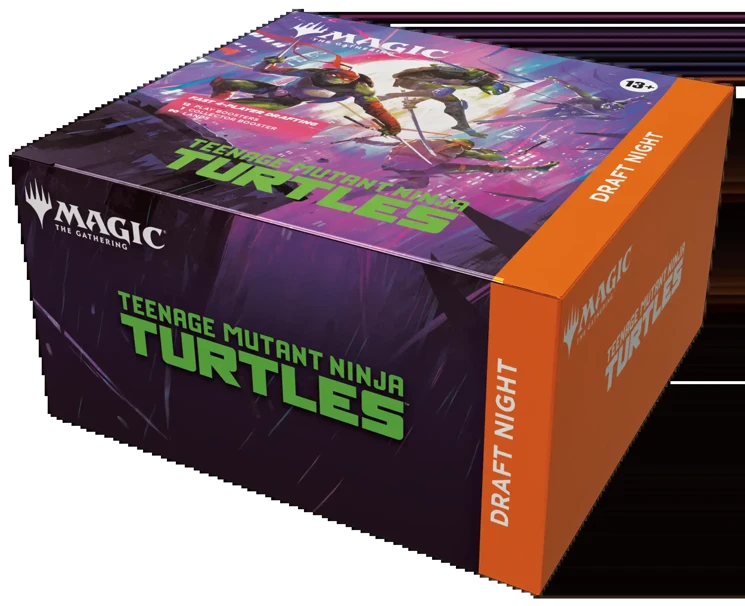
| Limited: Draft | 40+; 20 life | Select cards from packs, then build. Regular Draft uses 3 packs each; Draft Night supports four-player Pick-Two. PZA opened in these Play Boosters is playable. |
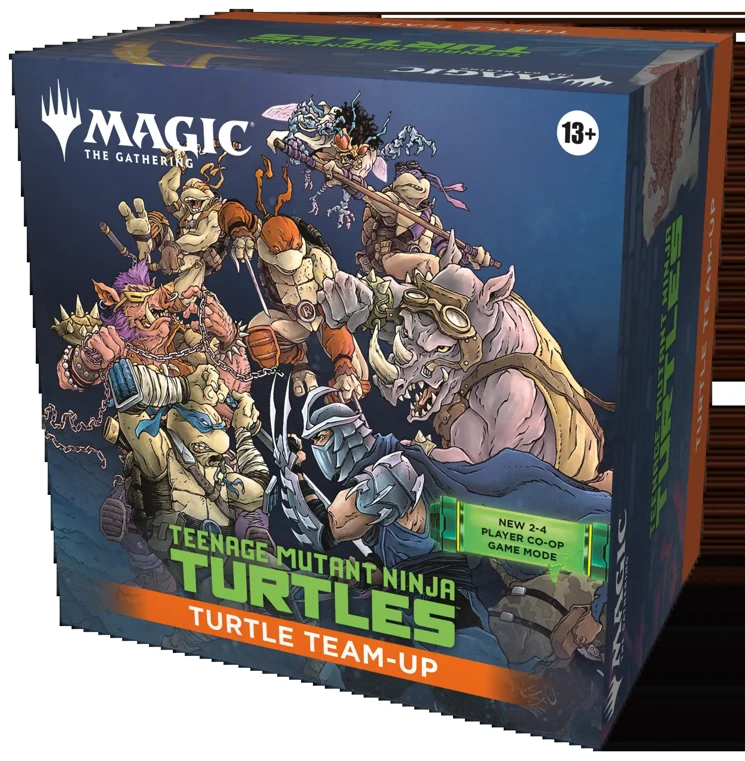
| Turtle Team-Up | Included decks; its own setup | 2–4 players cooperate against the enemy deck. Enemy cards are not normal cards for a Commander deck. |
Constructed tournaments commonly allow a sideboard of up to 15 cards, sharing the main deck’s four-copy limit. Commander does not have a default 15-card sideboard. Commons may be useful for Pauper, but check the name’s common printings and legality rather than relying on a premium treatment’s rarity.
Official legality by card group
9. Complete catalog: cards, numbers, and variants
No single number describes the entire release. The booster-focused core has 190 cards (#1–190): 67 commons, 55 uncommons, 53 rares, and 15 mythics. Five rooftop basic lands (#191–195) bring the base collection to 195 names. Of those 195 names, 187 are new cards and 8 are reprints, including the five basics.
| Group | Unique names | Numbered printings | Coverage |
|---|---|---|---|
| TMT | 195 | 320 | Core, lands, treatments, and Bundle promo. |
| TMC | 117 | 132 | 43 new Commander cards, 29 new Turtle Team-Up cards, 39 Commander reprints, and 6 Pizza Bundle promos. |
| PZA | 20 | 20 | Returning cards with source-material art. |
| Total for these codes | 332 | 472 | 259 new names and 73 reprints; 140 additional numbered variants. |
| Numbered printings | Common | Uncommon | Rare | Mythic |
|---|---|---|---|---|
| TMT | 94 | 68 | 106 | 52 |
| TMC | 17 | 13 | 78 | 24 |
| PZA | 0 | 0 | 0 | 20 |
Counts reflect an October 30, 2026 Scryfall query checked against Wizards’ core set and product descriptions. Unique cards are deduplicated by Oracle ID. A printing means one set code and collector number, not every language or finish. Some variants have different rarity metadata from the base version. Tokens, art cards, enemy cards, and Secret Lair are excluded from these totals.
Counting each finish listed in that database gives 605 TMT number/finish combinations, 214 TMC, and 40 PZA: 859 total. This is a metadata inventory, not 859 designs or a promise that every version is in stock. Gaps in TMC numbering do not mean missing cards: some names are printed under a different code.
Open a group below. Each row links to the card record and authentic image. Catalog images open on demand so the page does not download hundreds of cards on arrival. Use your browser’s Find within an expanded group, or the official gallery’s filters.
TMT · 195 unique card names
TMT · 125 additional numbered printings
TMC · 117 unique card names
TMC · 15 additional numbered printings
| # | Card | Rarity | Finish | Image |
|---|---|---|---|---|
| 83 | Leonardo, the Balance | Mythic | foil | View image |
| 84 | April O'Neil, Live on the Scene | Mythic | foil | View image |
| 85 | Donatello, the Brains | Mythic | foil | View image |
| 86 | Krang, the All-Powerful | Rare | foil | View image |
| 87 | Bebop, Skull & Crossbones | Rare | foil | View image |
| 88 | Shredder, Shadow Master | Rare | foil | View image |
| 89 | Splinter, the Mentor | Mythic | foil | View image |
| 90 | Casey Jones, Back Alley Brute | Rare | foil | View image |
| 91 | Raphael, the Muscle | Mythic | foil | View image |
| 92 | Michelangelo, the Heart | Mythic | foil | View image |
| 93 | Ninja Pizza | Rare | foil | View image |
| 94 | Rocksteady, Mutant Marauder | Rare | foil | View image |
| 95 | Super Combo | Rare | foil | View image |
| 96 | Heroes in a Half Shell | Mythic | foil | View image |
| 97 | Big Mother Mouser | Rare | foil | View image |
PZA · 20 unique card names
| # | Card | Rarity | Finish | Image |
|---|---|---|---|---|
| 1 | Path to Exile | Mythic | nonfoil/foil | View image |
| 2 | Teleportation Circle | Mythic | nonfoil/foil | View image |
| 3 | Trouble in Pairs | Mythic | nonfoil/foil | View image |
| 4 | Brainstorm | Mythic | nonfoil/foil | View image |
| 5 | Cytoplast Manipulator | Mythic | nonfoil/foil | View image |
| 6 | Ashcoat of the Shadow Swarm | Mythic | nonfoil/foil | View image |
| 7 | Plague of Vermin | Mythic | nonfoil/foil | View image |
| 8 | All Will Be One | Mythic | nonfoil/foil | View image |
| 9 | Silverclad Ferocidons | Mythic | nonfoil/foil | View image |
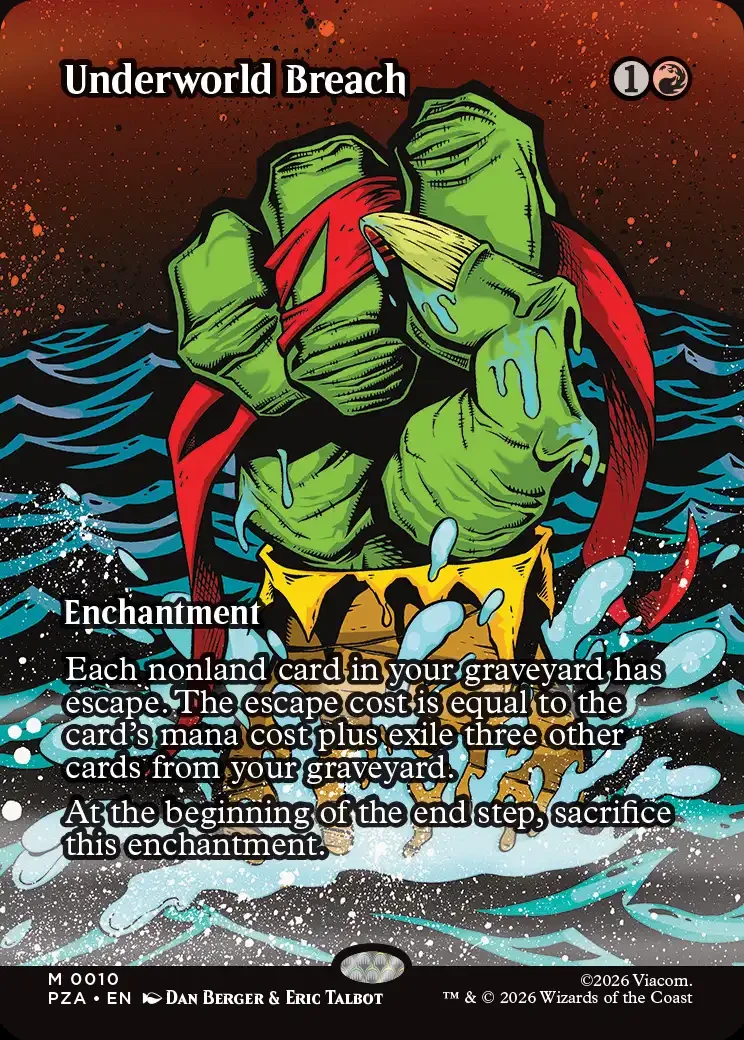
| 10 | Underworld Breach | Mythic | nonfoil/foil | View image |
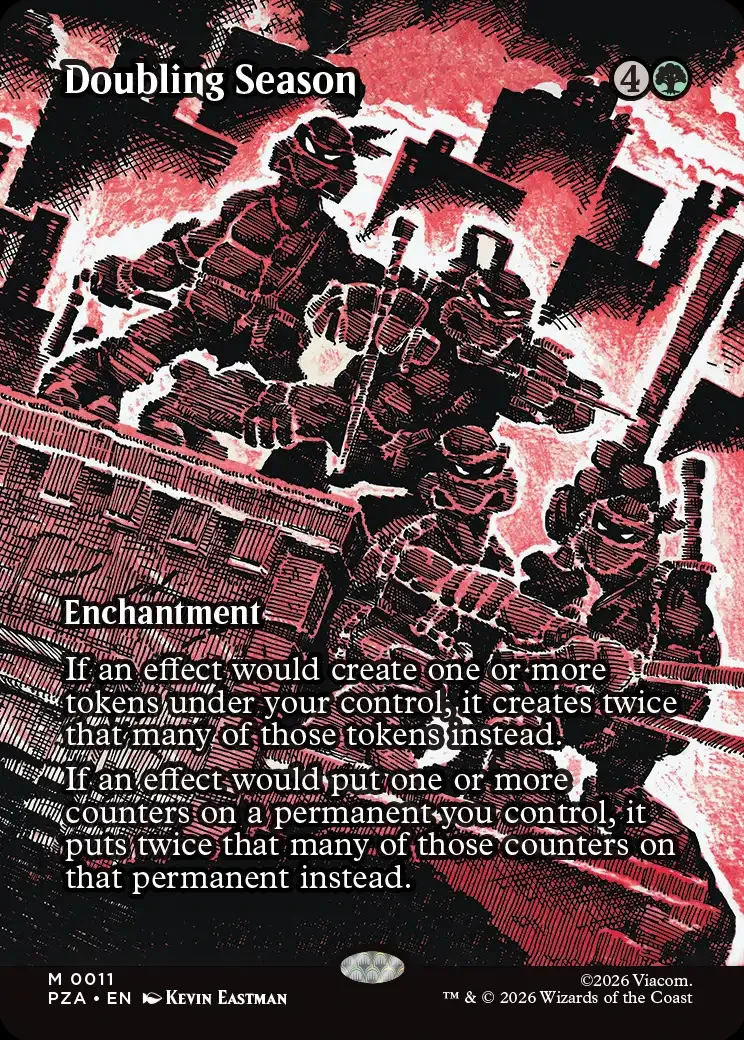
| 11 | Doubling Season | Mythic | nonfoil/foil | View image |
| 12 | Rhythm of the Wild | Mythic | nonfoil/foil | View image |
| 13 | Waves of Aggression | Mythic | nonfoil/foil | View image |
| 14 | Arcbound Ravager | Mythic | nonfoil/foil | View image |
| 15 | Conqueror's Flail | Mythic | nonfoil/foil | View image |
| 16 | Metallic Mimic | Mythic | nonfoil/foil | View image |
| 17 | Shadowspear | Mythic | nonfoil/foil | View image |
| 18 | Sword of Sinew and Steel | Mythic | nonfoil/foil | View image |
| 19 | Umezawa's Jitte | Mythic | nonfoil/foil | View image |
| 20 | Undercity Sewers | Mythic | nonfoil/foil | View image |
10. Strong cards and useful synergies
These are role-based recommendations, not a tournament-results ranking. A strong Commander engine may be too slow for a competitive duel. Evaluate cost, the advantage it creates, and what happens if it is removed.
| Card | Why consider it | Limitation |
|---|---|---|
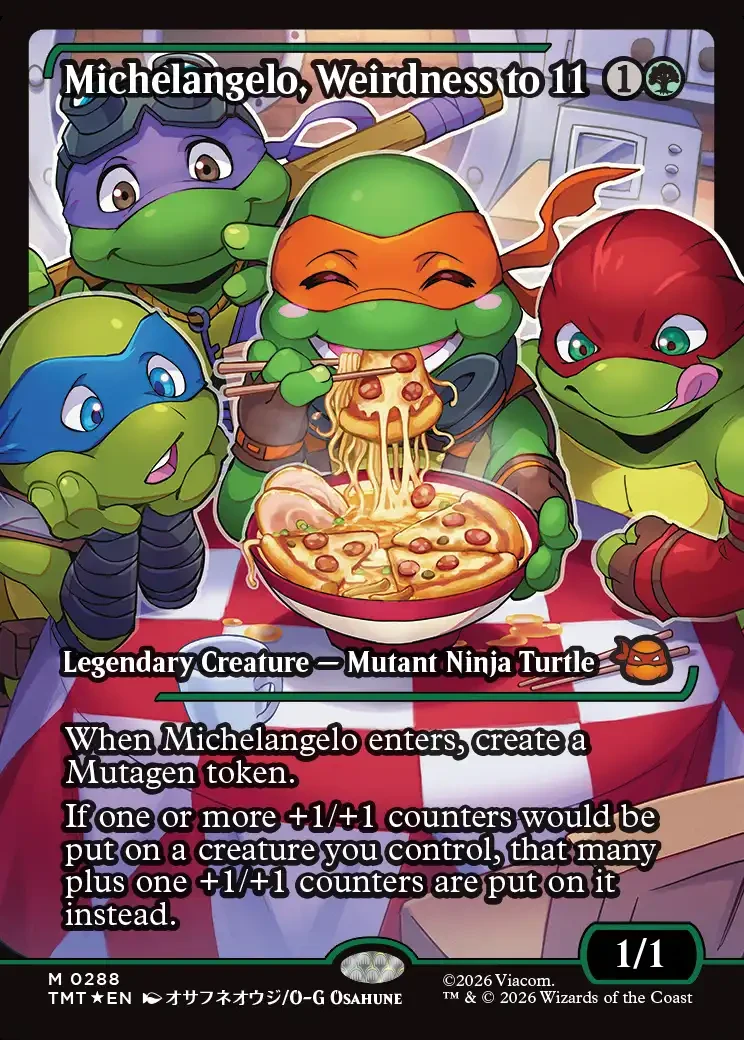
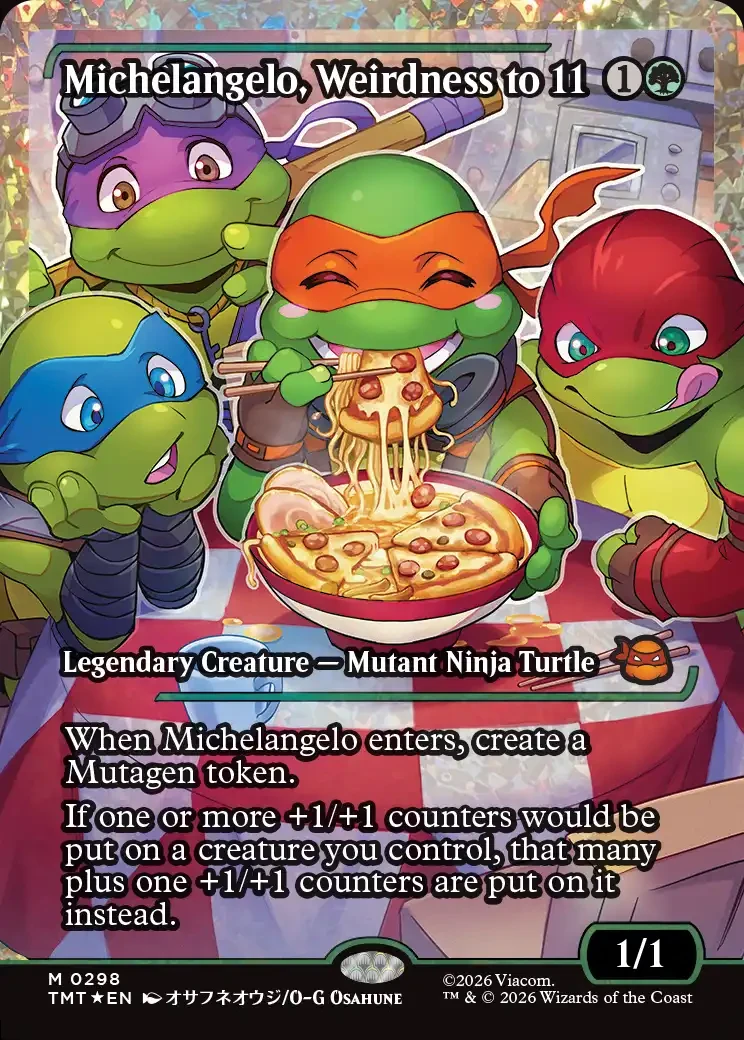
| Michelangelo, Weirdness to 11 | For 1G, supplies a Mutagen and improves each placement of +1/+1 counters. A natural counters engine. | A 1/1 that needs support and can die before providing value. |
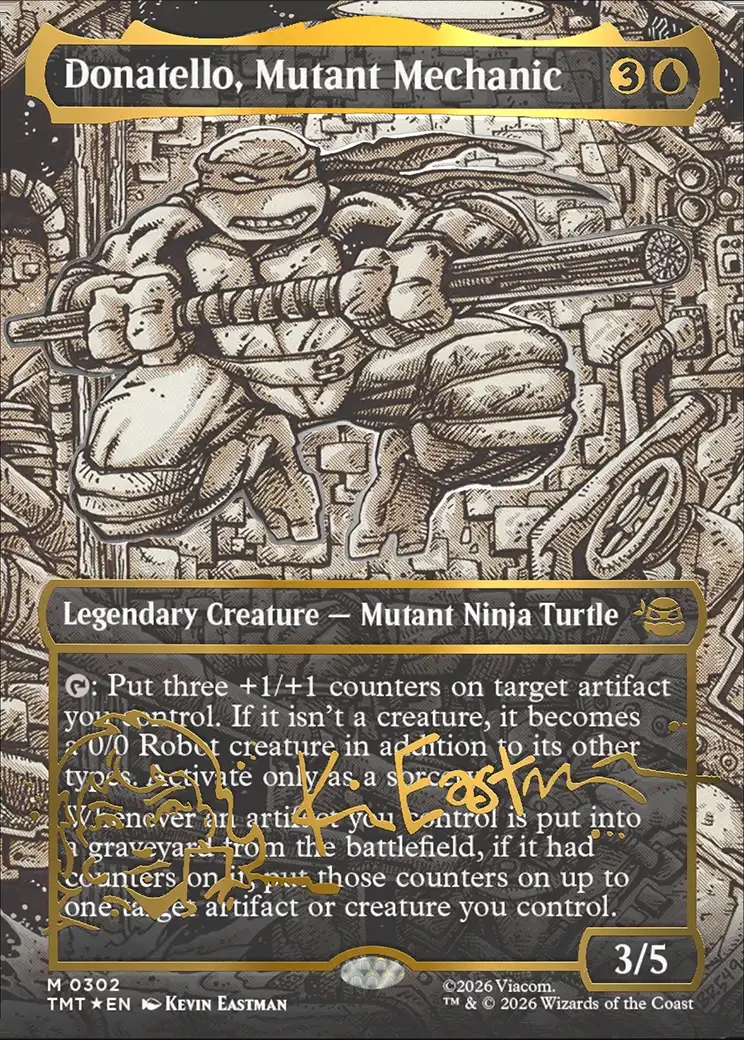
| Donatello, Mutant Mechanic | Turns small artifacts into threats and can move counters from your artifacts that go to the graveyard. | The tap ability normally waits a turn and is sorcery-speed. |
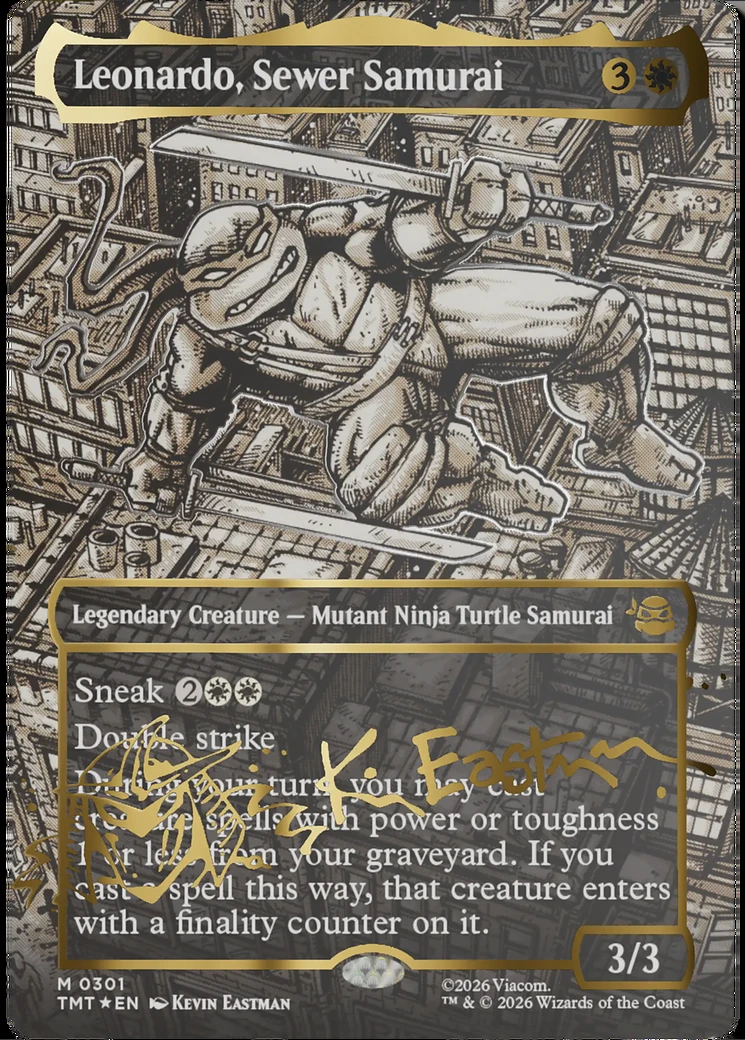
| Leonardo, Sewer Samurai | Double strike plus recasting small creatures from your graveyard provides pressure and resources. | You still pay their costs; finality limits repeated death loops. |
| Super Shredder | Grows when another permanent leaves, including opponents’ permanents. | Depends on the board, and removal can erase its investment. |
| The Ooze | Turns departing counter-bearing creatures into Mutagen and interacts with graveyards. | Needs the right shell; more tokens do not automatically supply more mana. |
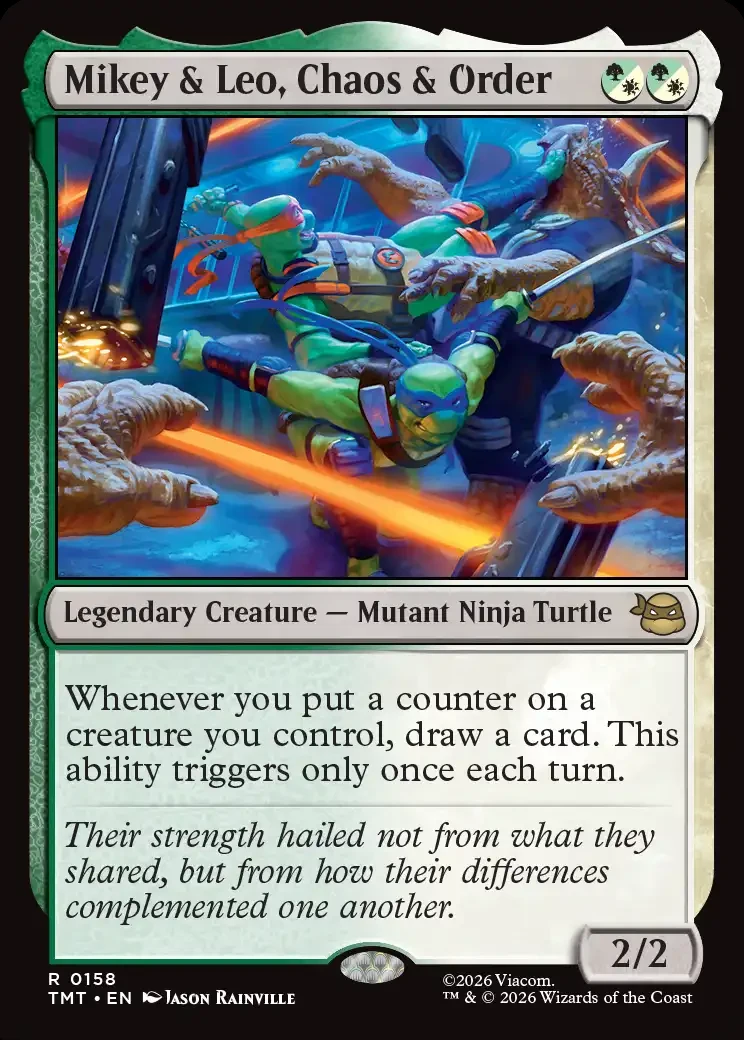
| Mikey & Leo, Chaos & Order | Turns placing a counter into a card draw. | Triggers only once each turn. |
| PZA: Underworld Breach / Doubling Season | Returning cards with established strategic uses outside the TMT core. | Their code does not grant Standard legality. Underworld Breach is banned in Modern, Pioneer, and Legacy in the checked data. |
For casual play, Michelangelo plus Mutagen is an approachable upgrade. Turtle Power! gives Commander players a counters-and-creatures starting point. For competitive play, begin with your format’s metagame: a strictly thematic deck can be weaker than one incorporating other sets.
11. Rarities, treatments, and valuable cards
Common, uncommon, rare, and mythic rare describe printing rarity. Foil describes a shiny finish. A foil common remains common, and a regular rare can be more useful than a mythic. Alternate artwork does not add gameplay abilities.
| Treatment | Identification and source |
|---|---|
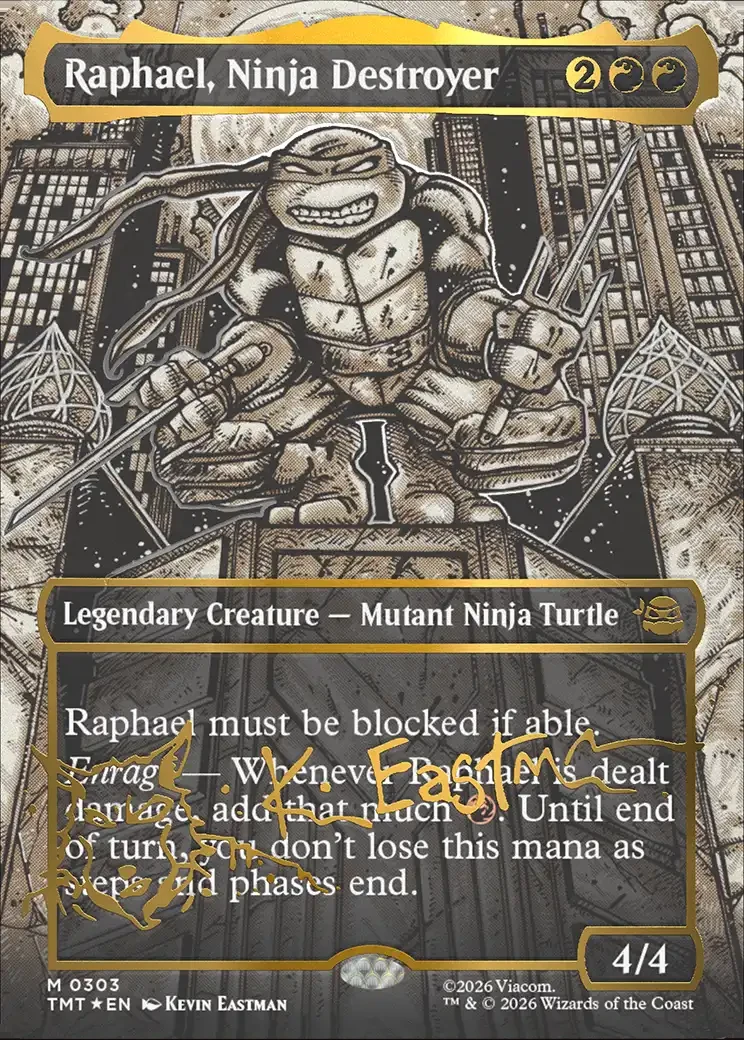
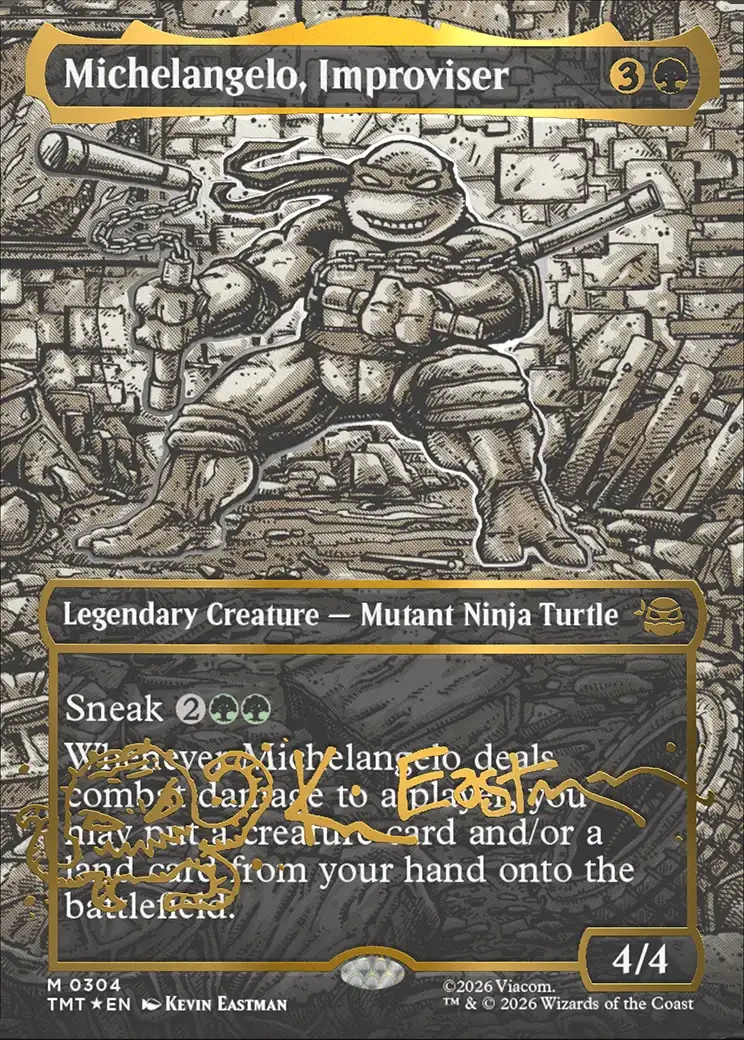
| Kevin Eastman Headliner | Four Turtles with Eastman artwork and stamped signatures; English only, in Collector Boosters. Do not confuse signed Art Cards with playable cards. |
| Silhouette | 8 borderless mythic treatments in Play and Collector Boosters. |
| Sewer frame | 30 treatments: 6 uncommon, 20 rare, and 4 mythic. In Play and Collector Boosters. |
| Japan Showcase | 10 designs; traditional and fracture foil in Collector Boosters. Japanese packs have Japanese versions; other languages have English versions. |
| Pixel | 15 new Commander cards with pixel artwork; surge foil in Collector Boosters. |
| Scene | 19 cards form three scenes of 4, 6, and 9 pieces. |
| Pizza / Rooftop lands | Five basic land types with different artwork. They do not introduce five new colors. |
| Promos | Bundle: Shark Shredder, Killer Clone #320. Pizza Bundle: two of six TMC #131–136 promos. Prerelease: a stamped foil rare or mythic. Some event promos come from other sets. |
Price snapshot: one card, very different collecting costs
Checked October 30, 2026. These US-dollar figures are aggregated price references supplied through Scryfall’s providers, not individually verified completed sales or guaranteed offers. Shipping, tax, and import costs are excluded. Indexed TCGplayer results may reflect another date or amount; compare the exact printing before paying.
| Card and number | Finish | USD reference | Record |
|---|---|---|---|
| Leonardo, Sewer Samurai #301 | Foil | US$ 2986.53 | Scryfall |
| Michelangelo, Improviser #304 | Foil | US$ 2483.32 | Scryfall |
| Donatello, Mutant Mechanic #302 | Foil | US$ 2233.83 | Scryfall |
| Michelangelo, Weirdness to 11 #298 | Foil | US$ 142.38 | Scryfall |
| Leonardo, Sewer Samurai #17 | Nonfoil | US$ 1.04 | Scryfall |
| Michelangelo, Weirdness to 11 #121 | Nonfoil | US$ 2.12 | Scryfall |
Among the versions with available data, Leonardo, Michelangelo, and Donatello Headliners sit far above their regular printings. Raphael #303 had no USD reference in the queried API, so no substitute figure is invented. We have not verified an individual multi-thousand-dollar sale or an exact Headliner pull rate. Wizards describes their appearance only as a low rate.
12. Start and protect your collection
- Choose a collection target: favorite characters, 195 TMT names, specific treatments, or multiple set codes. You do not need everything.
- Track set + number + language + finish: for example TMT 0017 EN nonfoil. Add quantity, condition, and storage location. #301 is another printing of Leonardo #17, not a new gameplay design.
- Buy singles for specific targets: random packs do not guarantee a favorite Turtle or treatment. Compare the complete cost with shipping and tax.
- Protect cards without stressing them: use standard-size Magic sleeves, a binder that does not pinch cards, and dry storage away from sunlight. Valuable cards can use compatible inner and outer sleeves without forcing them.
- Inspect condition: edges, corners, scratches, surface wear, creases, and curling. Near Mint does not necessarily mean flawless. Agree on photographs and condition before a trade.
- Use several authenticity checks: compare a known genuine copy of the same product; inspect print, typography, bottom line, and applicable stamp under magnification. Factory, finish, and language differences exist; no single home test proves everything. Never bend or tear a card as a test. For expensive purchases, seek a trusted store or specialist’s inspection.
- Trade like for like: confirm number and finish, compare same-date references, and agree on condition. An Art Card or token does not replace a playable card.
Keep Secret Lair under its own SLD set code. Totally TubuLair included six drops: VHS Villains, The Mighty Mutanimals, The Last Ronin, Kevin Eastman Colors, Kevin Eastman Inks, and Stan Sakai. Reskinned cards retain their rules identity; they are not automatically new designs or Standard legal. Check current direct-sale or secondary-market availability: the March announcement does not guarantee direct stock today.
13. What to buy for your goal
All main products below have been released. Check individual store, language, and regional stock when purchasing. Prices are Wizards’ published US MSRPs, not live store quotes. Retail pages checked list sealed products, but inventory changes.
| Product | Core contents | Ready to play? | US MSRP |
|---|---|---|---|
| Turtle Team-Up | Four 60-card decks, 38-card enemy deck, 4 Play Boosters, booklet, accessories | Ready for 2–4-player co-op. Best entry for learning together. | $49.99 |
| Turtle Power! Commander | 100-card deck; six featured foil commanders within those 100, 10 tokens, box | Ready for one player; opponents need their own Commander decks. More complex. | $69.99 |
| Play Booster | 14 cards and a token; 30 packs per display | Not a deck. For Limited or pack opening. | $6.99 / pack |
| Collector Booster | 15 cards; foil token or Art Card; 12 packs per display | Not a deck. For premium treatments. | $37.99 / pack |
| Bundle | 9 Play Boosters, 30 lands (15 foil), promo, die, box | No preconstructed deck. For opening and storage. | $69.99 |
| Pizza Bundle | 9 Play + 1 Collector, 30 pizza lands (5 foil), 2 of 6 promos, die, box | Not preconstructed. For pizza-land collectors and opening. Released March 27. | $99.99 |
| Draft Night | 12 Play + 1 Collector, 90 basic lands, 10 tokens, instructions | Four-player Pick-Two Draft supplies; you must build decks. | $119.99 |
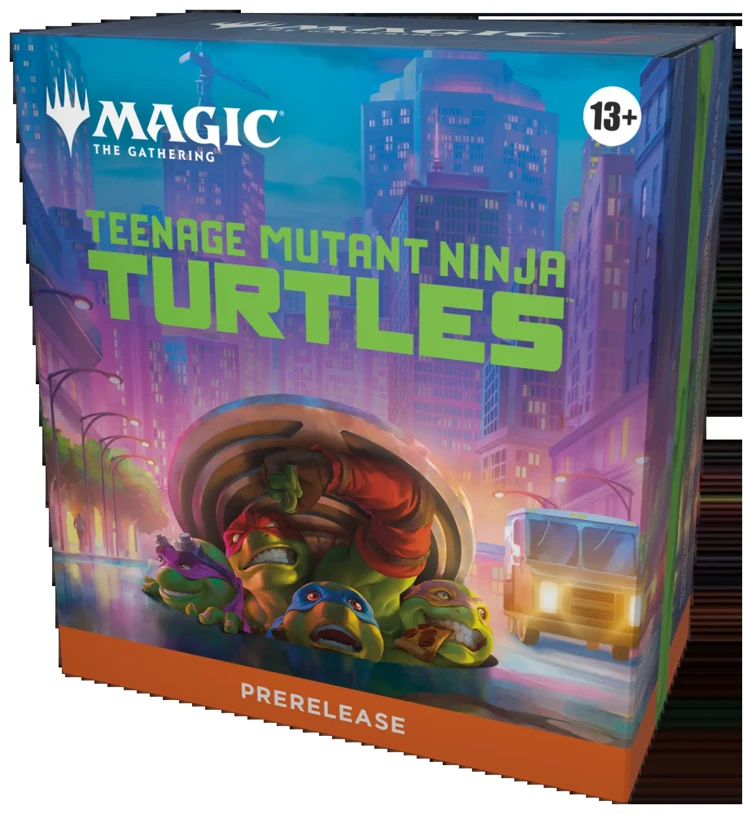
| Prerelease Pack | 6 Play, foil rare/mythic, die, box | Build a 40-card deck; extra basic lands required. | Store/event dependent |
| Singles | Your chosen card, language, finish, condition | Best for a specific deck or collection target. | Printing dependent |
| Secret Lair / tins | Specific drops or alternate retail packaging | Check exact contents: a tin does not imply a deck. Outside the main catalog count. | Product dependent |
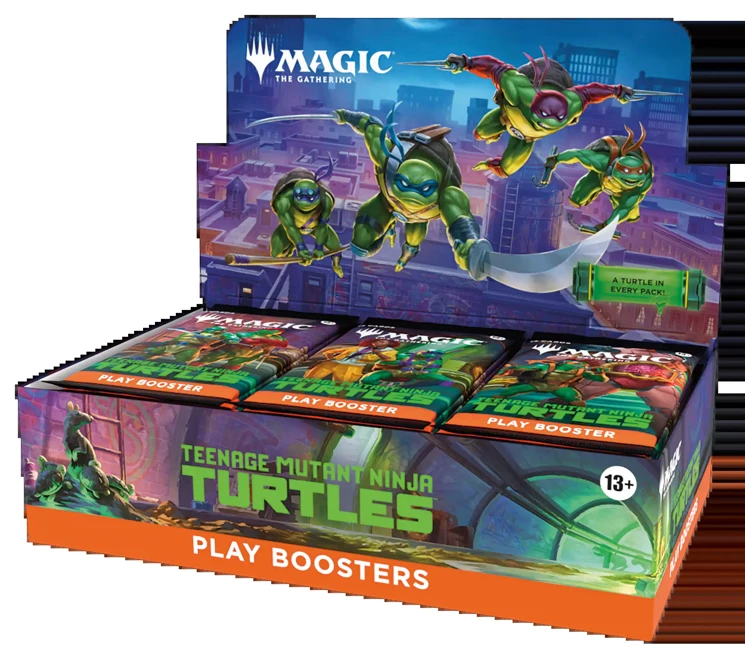
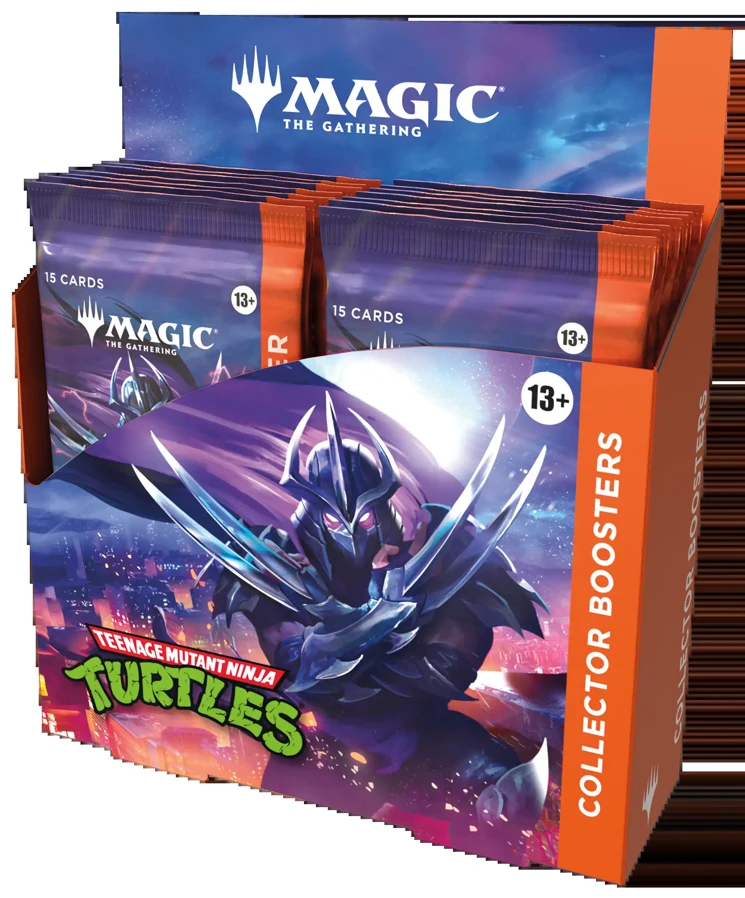
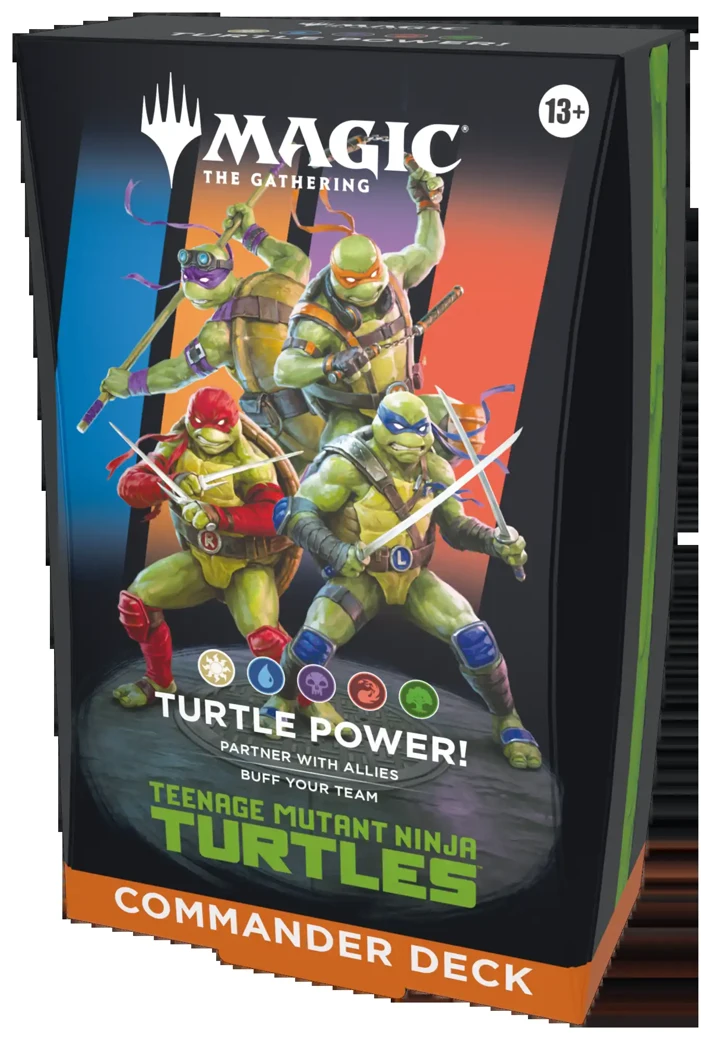
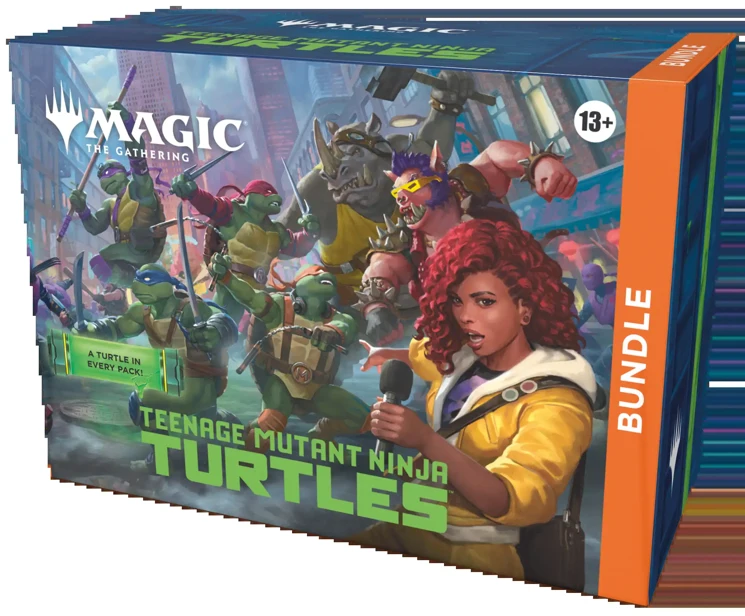
Play Boosters are printed in English, Spanish, French, German, Italian, and Japanese. Do not assume every product and treatment exists in all six languages: verify the SKU or packaging. Headliner and Japan Showcase language exceptions are covered above.
14. Common mistakes and how to avoid them
- Confusing lands and mana: a land produces a resource and stays in play. You also cannot normally play every land in your hand at once.
- Casting everything at any time: creatures and sorceries normally wait for your main phase and an empty stack. Sneak is a specific exception, not general permission.
- Attacking creatures: you normally attack a player; the defender chooses blocks.
- Using Mutagen during combat: its activation is sorcery-speed only.
- Confusing damage and counters: damage clears; +1/+1 counters stay until removed or the object changes zones.
- Skimping on lands: build a reliable mana base before adding expensive spells.
- Assuming any card can command: normally it must be a legendary creature; color identity and construction rules still apply.
- Equating rarity with strength: buy gameplay function; premium finishes are a collecting choice.
- Assuming you need lots of packs: a preconstructed deck or a singles list gets you started without chasing random contents.
15. An at-the-table glossary
Use the mana, zone, and combat diagrams alongside these definitions. Original mana symbols: 


 .
| Term | Meaning |
|---|---|
| Mana | Resource used to pay costs; not the same thing as a land. |
| Tap | Turn a card sideways; the curved-arrow tap symbol asks you to do this. |
| Permanent | An object on the battlefield, such as a creature, land, or artifact. |
| Draw | Put the top card of your library into your hand. |
| Sacrifice | Put a permanent you control into its owner’s graveyard. Different from destroy. |
| Target | A choice designated by the word target; it may become illegal before resolution. |
| Counter a spell | Stop a spell or ability from resolving; different from putting counters on an object. |
| Counter on a permanent | A marker tracking or modifying something; +1/+1 increases power and toughness. |
| Token | An object created by an instruction; not a card in your starting deck. |
| Flying | Can be blocked only by creatures with flying or reach. |
| Reach | Can block flying creatures. |
| Haste | Allows attacking and tap-symbol abilities without waiting a turn. |
| Vigilance | Attacking does not cause it to tap. |
| Deathtouch | Any positive damage it deals to a creature is normally lethal. |
| Trample | Can assign excess damage to the defender after assigning lethal to blockers. |
| Menace | Cannot be blocked except by two or more creatures. |
| First strike | Deals damage in a step before regular combat damage. |
| Double strike | Deals damage in the first and regular damage steps if still in combat. |
| Flash | May be cast whenever you could cast an instant. |
| Ward | When an opponent targets it, counters that spell or ability unless they pay the listed cost. |
| Indestructible | Lethal damage and destroy effects do not destroy it; exile or zero toughness can still remove it. |
| Mana value | Number derived from mana cost; 2G normally has mana value 3. |
| Color identity | In Commander, considers mana symbols in cost and rules text and relevant indicators; not reminder text. |
| Mutagen | Artifact token exchanged for a +1/+1 counter by paying 1, tapping, and sacrificing at sorcery speed. |
| Sneak | Alternative cost returning an unblocked attacker in your declare blockers step. |
| Disappear | Ability word highlighting a permanent leaving under your control that turn. |
| Alliance | Ability word highlighting another creature entering under your control. |
| Lifelink | Damage it deals also causes you to gain that much life. |
| Scry | Look at the indicated number of top cards; put any on the bottom and the rest on top in your chosen order. |
| Mill | Put cards from the top of a library into its graveyard. This is not drawing. |
| Channel | An ability word highlighting activated abilities that commonly discard the card from your hand. |
| Landcycling | Pay the cost and discard the card to search for the specified land type; reveal it, put it in your hand, and shuffle. |
| Equip | Pay to attach Equipment to a creature you control, normally at sorcery speed. |
| Crew | Tap other untapped creatures with sufficient total power to make a Vehicle an artifact creature until end of turn. |
| Affinity | Reduces generic cost based on the specified permanents you control; does not reduce colored symbols. |
| Kicker | An optional additional casting cost that improves the effect as the card specifies. |
| Enrage | Highlights triggers when that creature is dealt damage. Raphael, Ninja Destroyer produces red mana. |
| Landfall | Highlights triggers when a land enters under your control. |
| Fight | Two creatures deal damage equal to their power to one another; this is not combat and does not tap them. |
| Enchant | Specifies what an Aura can attach to; casting it normally requires that target. |
16. Frequently asked questions
Can I play with only TMNT cards?
Yes: the green list above is a legal thematic starting point. One random pack is not enough, and restricting yourself to one release limits options.
Can I mix English and Spanish cards?
Yes. Language does not change identity or legality. Use official names and Oracle text for questions; you can learn with cards printed in a language you read.
Can I combine other sets?
Yes, subject to format legality, colors, and construction rules. Knowledge of Magic’s story is not required.
Can I learn without buying cards?
Yes. MTG Arena’s free tutorial teaches the general rules, though it does not guarantee immediate access to every TMNT card. You can also ask a local store for a demonstration.
Are Turtle Team-Up and Turtle Power! the same?
No. Team-Up includes four decks for cooperation against automated enemies; Turtle Power! is one 100-card Commander deck.
Is a Headliner stronger?
No. Artwork and a stamped signature change collectibility, not abilities. Compare Leonardo #17 and #301.
Can I play with Art Cards?
Art Cards are collectibles, not the playable cards they depict. Tokens are not shuffled into a starting deck either.
How do I know whether my card is valuable?
Match the exact set, number, language, finish, and condition. Compare listings and completed sales separately; an asking price does not establish a completed sale.
Does opening a PZA card make it Standard legal?
Only if that name is otherwise Standard legal. In a Draft or Sealed event using these boosters, a PZA card opened in your pool is playable.
Can I control two different Leonardos?
Yes, if their full card names differ. The legend rule compares full names, not the character they represent.
Sources and image credits
- Official rules / Reglas oficiales
- Release notes / Notas de la colección
- TMNT mechanics / Mecánicas TMNT
- Collecting TMNT / Coleccionismo
- WPN product specifications / Productos
- Turtle Power! official decklist / Lista oficial
- Commander design / Diseño del mazo
- Totally TubuLair Secret Lair
- Official card gallery / Galería oficial
- Banned and restricted / Prohibidas y restringidas
Scryfall TMT · Scryfall TMC · Scryfall PZA · MTGJSON
Card and packaging images: Wizards of the Coast / ©2026 Viacom International Inc.; individual illustrators are credited beside the cards. Original educational diagrams: ArcadeBot. This is unofficial fan content, not approved or endorsed by Wizards. Portions of the materials are property of Wizards of the Coast and Viacom. Authentic artwork is shown for identification and education.