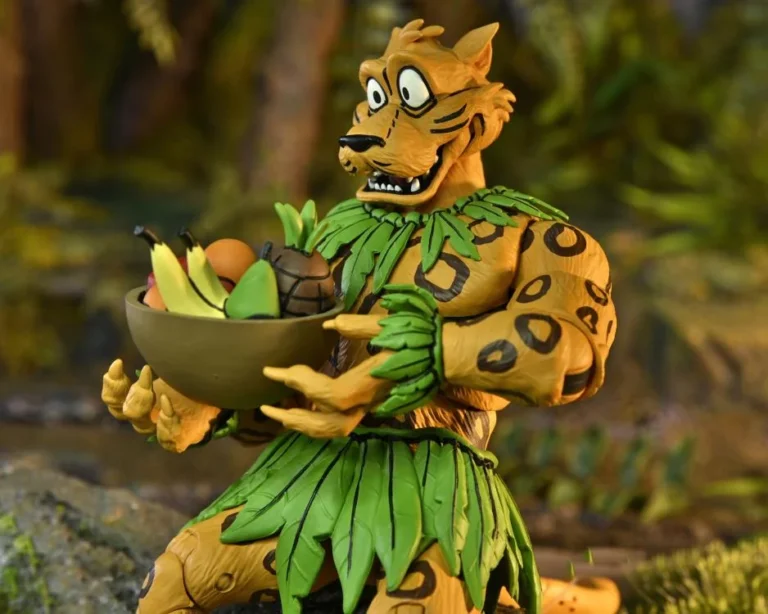
Fugitoid is Professor Honeycutt, a scientist trapped in a robotic body who becomes an ally of the Teenage Mutant Ninja Turtles. His name combines fugitive and android. Military powers pursue him because they want to turn his scientific discoveries into weapons.
Kevin Eastman and Peter Laird were already developing Fugitoid in 1983, before they created the Turtles. His later incarnations share that basic conflict, but they do not share one biography: Honeycutt’s homeworld, transformation, family, and even the nature of his mechanical body vary between continuities.
This ArcadeBot video introduces the character in Spanish. The article below expands on his publishing history, separates the different versions, and examines his games and action figures.
Who is Fugitoid, and what is his real name?
The person behind the metal face is Professor Honeycutt, known in later versions as Zayton Honeycutt. An inventor who would rather solve problems through science, he repeatedly finds himself working near people who value his discoveries mainly for their military potential.
In the original Mirage story, Honeycutt lives on D’Hoonib and works on two separate inventions. The Mentawave Helmet amplifies mental abilities; the Transmat transports matter. The helmet is involved in his transformation, while the teleporter is the technology his pursuers want to control.
Fugitoid is therefore more than a helpful robot. He has memories, fears, judgment, and a conscience. His first adventure turns on a disturbing change in his legal status: General Blanque believes a machine has no rights, so the robotic Honeycutt can be forced to work. A science fiction accident becomes a struggle over freedom and responsibility.
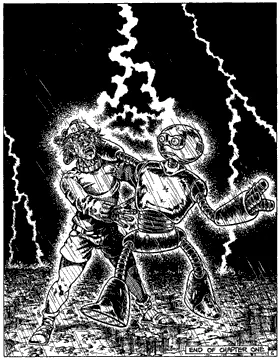
Fugitoid’s origin before the Teenage Mutant Ninja Turtles
1983: the comic that was supposed to unfold into a poster
A particularly useful historical record is a letter Peter Laird wrote on April 25, 1983, later reproduced on his blog. He describes a project called Fugitoid that he is developing with Kevin. The letter establishes that Fugitoid existed by that date; it does not establish the exact day they first invented him.
The proposed format was a folded sheet containing four comic pages and a large image revealed when the sheet opened. That version never reached publication. Laird later explained that the plan left a visible mark on the artwork: large images at regular intervals were originally intended as poster pages. It helps explain the unusual pacing and frequent full-page compositions of the eventual comic.
1984: what actually appeared in Gobbledygook?
Gobbledygook #1 and #2 were small photocopied publications by Eastman and Laird, containing early Fugitoid chapters alongside other material. They should not be described as two separately published issues of an ongoing comic called Fugitoid.
The first issue also carried a back-cover advertisement for Teenage Mutant Ninja Turtles #1. The often repeated print run of approximately 50 copies is a reported production figure, as described in auction documentation; it is not a count of surviving copies.
1985: Fugitoid #1 leads into TMNT #5
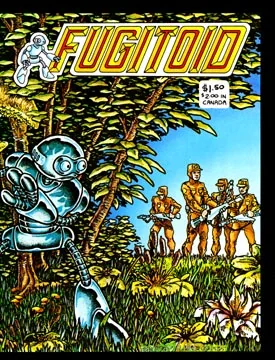
Mirage collected and completed the adventure in Fugitoid #1. Its official archive identifies the publication year, 37 story pages, and its distinction as Mirage’s first comic with a full-color cover. The interior remained black and white.
The ending connects to Teenage Mutant Ninja Turtles, volume 1 #5, with the Turtles arriving in front of the fleeing robot in Peblak. Three milestones should be kept separate: development documented in 1983, publication in Gobbledygook in 1984, and integration into the Turtles’ space adventure in 1985. Catalogs disagree about the one-shot’s publication month; Mirage’s archive confirms the year without specifying a day.
For more background on the collaboration, see Kevin Eastman’s story.
Fugitoid in the comics: separate worlds, separate histories
Spoilers follow for major Fugitoid stories. Each subsection concerns its own continuity.
Mirage: a scientist caught between rival armies
Honeycutt is still wearing the Mentawave Helmet when he goes outside to help SAL. Lightning strikes them, leaving his mind inside the robot. Soldiers discover the scientist’s body and assume SAL killed him. Blanque subsequently learns what happened and decides to capture him for his knowledge.
The Federation and the Triceratons both want the Transmat: a machine capable of moving troops or weapons across space could change the outcome of their war. The Turtles, transported to D’Hoonib by Utrom technology, become Honeycutt’s companions on the run. The adventure unfolds through TMNT #5–7, taking them into Triceraton captivity and combat.
Science fiction was already part of TMNT through the Utroms. Fugitoid expands that element of the setting; he should not be credited with originating every alien concept or with creating the publishing history of Krang.
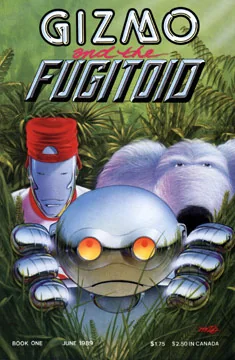
His adventures also extend beyond that first encounter. Gizmo and the Fugitoid #1–2 teams him with Michael Dooney’s characters; the first issue appeared in June 1989. In volume 4 of TMNT, issue #5 reunites him with Raphael and Michelangelo, while #14 has him helping investigate Raphael’s transformation.
IDW’s main continuity: a lost family and a hidden identity
The main IDW series reimagines Honeycutt as a Neutrino scientist involved in Krang’s technology. TMNT Micro-Series #8: Fugitoid (2012), written by Paul Allor and illustrated by Paul McCaffrey, reveals his background.
Here, Honeycutt enters SAL to rescue families trapped during an attack on a resistance base. His biological body dies, trapping him inside the android. He frees the civilians, but Granitor’s forces then kill them, including his wife Marra and son Ely. This is a deliberate rescue attempt with tragic consequences, rather than Mirage’s lightning accident.
After escaping to Earth, he uses his new body’s ability to change appearance to become Chet Allen, a StockGen employee. Working inside Baxter Stockman’s organization gives him a chance to undermine Krang. The Chet identity also connects Fugitoid to events planted early in the ongoing series.
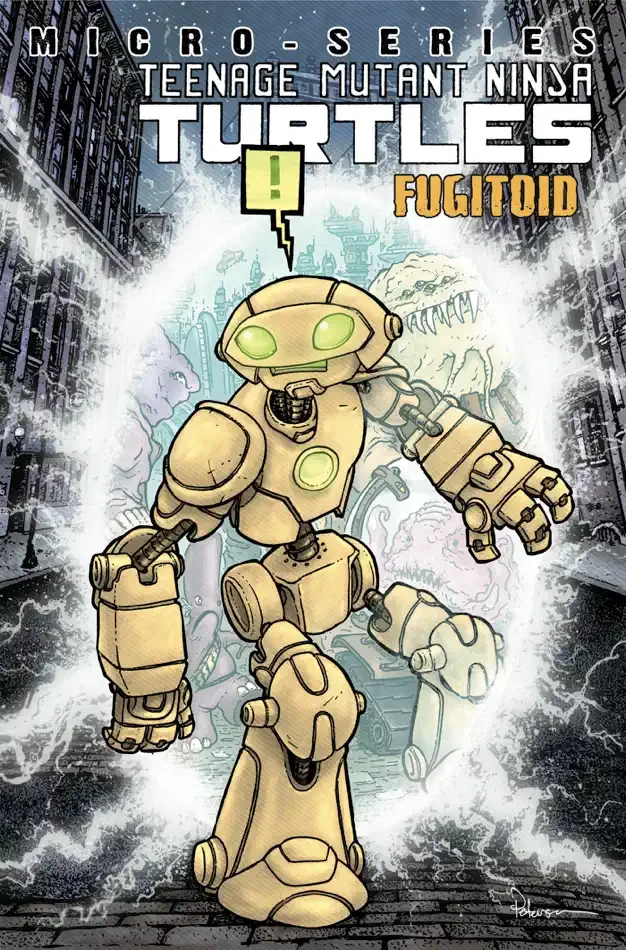
Several later stories show how much his role grows: Donatello’s crisis and recovery across TMNT #44–50, the attack that tears Honeycutt apart in #56, and the trial of Krang in #73–75. His relationships with the Utroms and Leatherhead complicate the distinction between opposing Krang and condemning Krang’s entire species.
The fleet-destroying computer-virus sacrifice sometimes assigned to this incarnation belongs to the 2003 animated series. For the main IDW comic’s broader sequence, consult our IDW TMNT reading order and timeline.
The Last Ronin: published by IDW, but a different continuity
One publisher can produce several unrelated versions of the character. Honeycutt also has a significant role in The Last Ronin, involving Baxter Stockman and the survival of his consciousness. His presence continues in The Last Ronin II: Re-Evolution, where issue #2 places him in an important conversation with April. These events do not belong in Chet Allen’s biography.
Tales of the TMNT: a teenage E.P.F. scientist
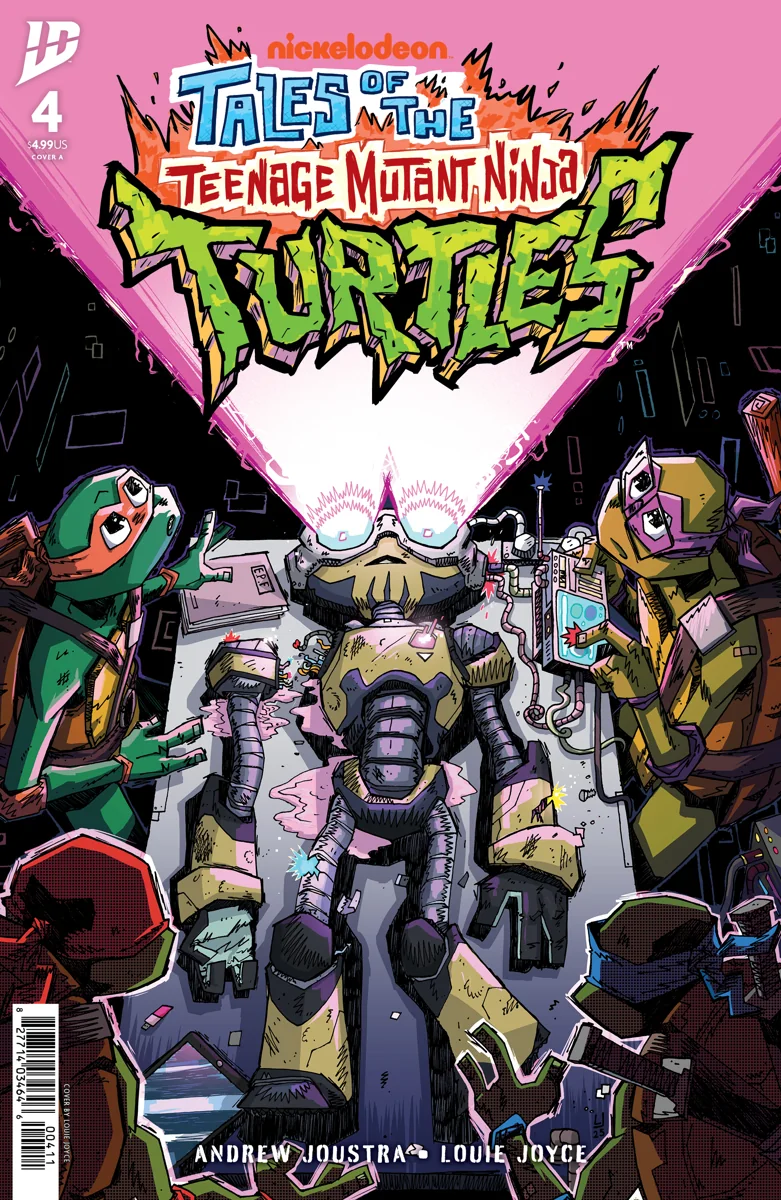
Tales of the Teenage Mutant Ninja Turtles #4–6 introduces Fugitoid into the world of Mutant Mayhem. The distributor lists issue #4’s release as March 18, 2026.
Writer Andrew Joustra explained that this Zayton is 19 years old. The Earth Protection Force funds his research, but wants to apply it to controlling living beings. The mental interface, SAL, and his escape remain recognizable, while the conflict moves to a terrestrial organization and a scientist much closer to the Turtles’ age.
Joustra also identified the original gold-and-black Playmates figure as a design reference. The story is collected in Fugitoid Frenzy. Although the comic is based on the animated show, Fugitoid’s appearance here is a printed story, not evidence that an episode featuring him has aired.
Fugitoid in the animated series
1987: an action figure does not establish a cartoon appearance
Fugitoid did not have a role in the original 1987 animated series. Playmates’ 1990 toy came from a range that included characters beyond the television cast. Explaining his absence by claiming the show avoided space adventures would also be misleading: the classic cartoon featured aliens, other dimensions, and space travel.
2003: Turtles in Space and Worlds Collide
His animated debut comes in Turtles in Space, Part 1: The Fugitoid, first broadcast in the United States on November 8, 2003. Oliver Wyman voices the professor. The adaptation retains D’Hoonnib, SAL, the helmet accident, and the Federation–Triceraton conflict.
The space adventure opens season two. Honeycutt’s story becomes central again during season three’s Space Invaders and Worlds Collide arcs. He erases the Teleportal information from his memory and attempts to surrender so the hunt for him will not destroy Earth.
He ultimately introduces a virus into the fleets’ systems, losing his body in the process. His mind survives through Earth’s satellite network, however, and Leatherhead builds him another body. The resolution returns to the question at the heart of Fugitoid: destroying his mechanical shell does not necessarily destroy the person inside.
2012: David Tennant, the Ulixes, and the Black Hole Generator
Voiced by David Tennant, Nickelodeon’s Fugitoid arrives at the end of season three in Annihilation: Earth!. He rescues the Turtles, April, and Casey as the Triceratons destroy Earth, then leads them on a space mission to prevent that outcome.
Aboard the Ulixes, the group travels six months into the past and searches for the pieces of the Black Hole Generator. This incarnation changes the transformation as well: Honeycutt’s biological body was destroyed, but his brain was saved and installed in a mechanical body. That is different from Mirage’s mind-transfer accident.
In season four’s Earth’s Last Stand, he admits that he created the device and sold it to the Kraang. His companions discover that their guide helped cause the disaster he wants them to avert. Honeycutt eventually sacrifices himself to destroy the weapon and the Triceraton fleet.
The final shot of his head reactivating shows that some part of him still functions. It supports discussing a suggested survival on screen. It does not establish an unseen series of later adventures or an undocumented promotional confirmation of his future.
How the different Fugitoids compare
| Version | Origin and body | Conflict and relationships |
|---|---|---|
| Mirage | D’Hoonib scientist; lightning transfers his mind into SAL. | Pacifist pursued by Blanque and the Triceratons; ally of the Turtles and Utroms. |
| Main IDW continuity | Neutrino scientist who enters SAL during a rescue. Can assume a human appearance. | Krang and Granitor; loss of his family; Chet Allen identity and StockGen infiltration. |
| 2003 animation | Adapts Mirage’s accident; later receives a replacement body. | Federation and Triceratons; fleet virus; assistance from Leatherhead. |
| 2012 animation | A preserved biological brain inside a white robotic body. | Ulixes guide; responsibility for the generator; confrontation with the Triceratons. |
| 2026 Tales comic | A 19-year-old human whose mind becomes trapped in his android. | Escapes the E.P.F. and joins the Turtles against its mind-control technology. |
Fugitoid in video games: fighter, supporting character, or cameo?
Being present in a game does not make a character playable. Console and handheld adaptations of the same title can also differ, so an appearance should not automatically be assigned to every edition.
| Game | Role |
|---|---|
| TMNT 2: Battle Nexus (2004) | Supporting character in the adventure based on the 2003 show, connected to the escape on D’Hoonib. Not a selectable fighter in the main console campaign. |
| TMNT 3: Mutant Nightmare (2005) | Narrative role in the adaptation of the Triceraton conflict. A story appearance should not be described as playable. |
| TMNT: Smash-Up (2009) | Unlockable fighter and part of the plot: Shredder captures him. The game was released for Wii and PS2. |
| TMNT: Mutant Madness (2020) | Recruitable character documented in the mobile game’s character catalogs. |
| Shredder’s Revenge: Dimension Shellshock (2023) | Background cameo in the expansion’s stages. It does not make him a playable character. |
What about TMNT: Legends? Fugitoid is not included here as playable: he does not appear in the consulted catalog of 83 selectable characters. References in the Space Turtles’ biographies and fan requests do not establish that he can be recruited. Legends and Mutant Madness are separate games.
The major Fugitoid action figures
Fugitoid’s toys span several eras of TMNT. The following are major documented releases; a new package or a rerelease is not necessarily a separate sculpt.
Playmates: 1990, 2004, and 2015
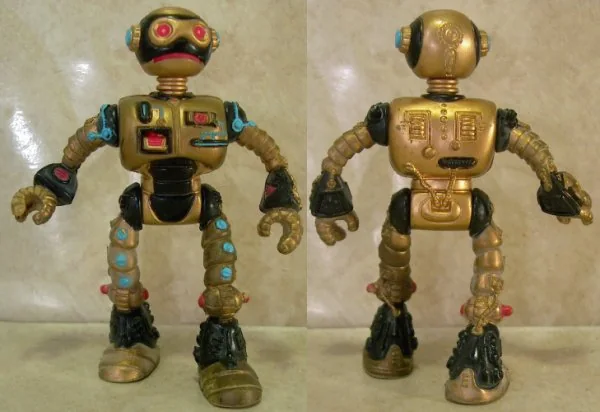
1990: the original toy line. The first figure uses gold, black, and colored details. Its character card lists an Electro-Stun Stick, Metal-melting Machine Gun, Grappling Claw, and Skeletal Scanner. Those accessories belong to the toy’s presentation, rather than to a nonexistent appearance in the 1987 cartoon.
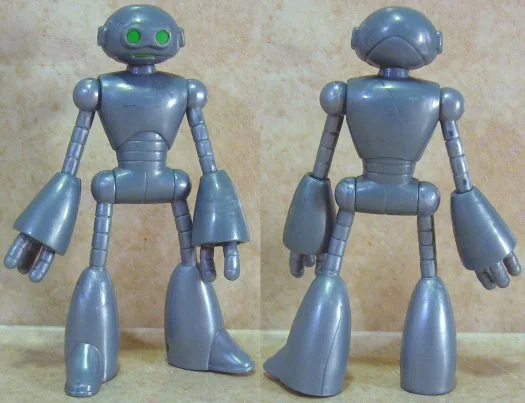
2004: the 2003 animated series. The silver figure reflects the show’s elongated limbs and large eyes. The archive records several packaging versions, including DVD editions. A reference to the Transmat in a character biography should not be mistaken for proof that every release contained a separate teleporter accessory.
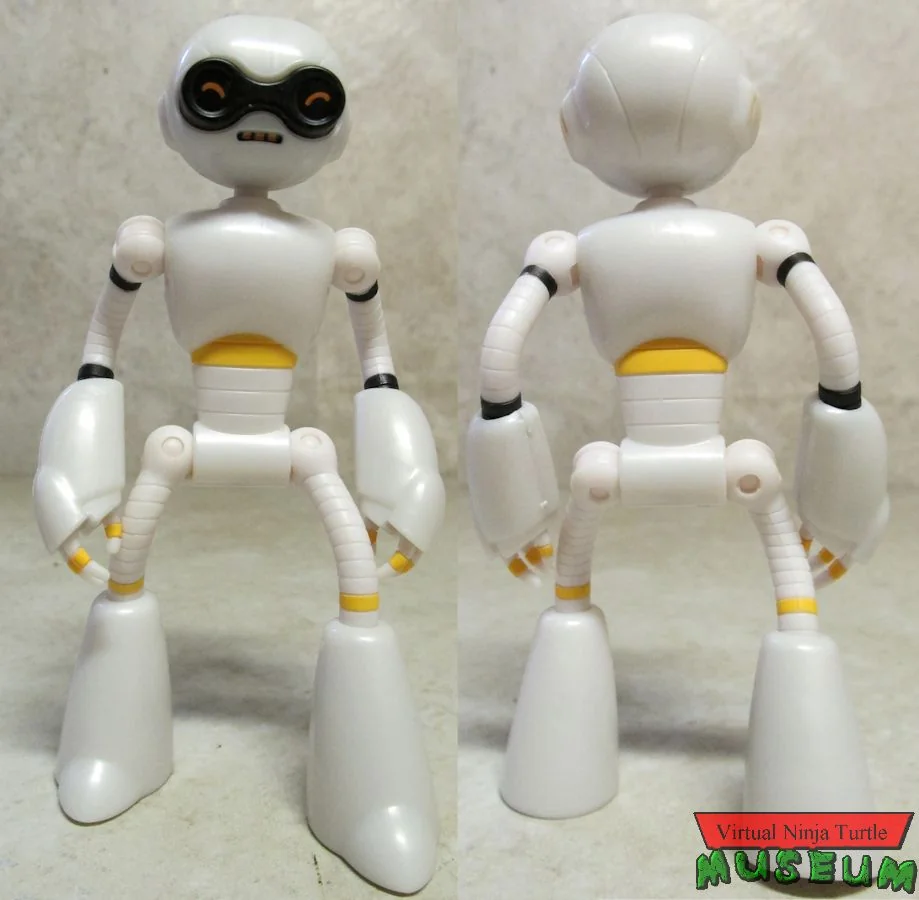
2015: Nickelodeon’s series. The basic figure has a white body and dark face panel. The archived package dates to 2015, so the release should not be moved to 2016 simply because part of the space storyline aired that year. The Ulixes vehicle is a separate product.
2009: Peter Laird’s vacuum-metalized Fugitoid
Kevin Eastman’s store documents a Playmates piece manufactured in 2009, commissioned by Peter Laird and developed from Michael Dooney’s designs. It has a vacuum-metalized finish, stands approximately 4.5 inches tall, and has no articulation. It was a Mirage/Eastman item rather than a conventional retail release, supplied in a plain white box.

NECA: 2022 Mirage Fugitoid and 2025 Transmat variant
Mirage, 2022. NECA reproduced the comic design with painted shadows and comic-book tribute packaging. The figure stands approximately 5.5 inches, or 14 cm. The product’s “7-inch scale” label describes the range, not this particular character’s exact height. It includes interchangeable hands and weapons compatible with other NECA Turtles figures.

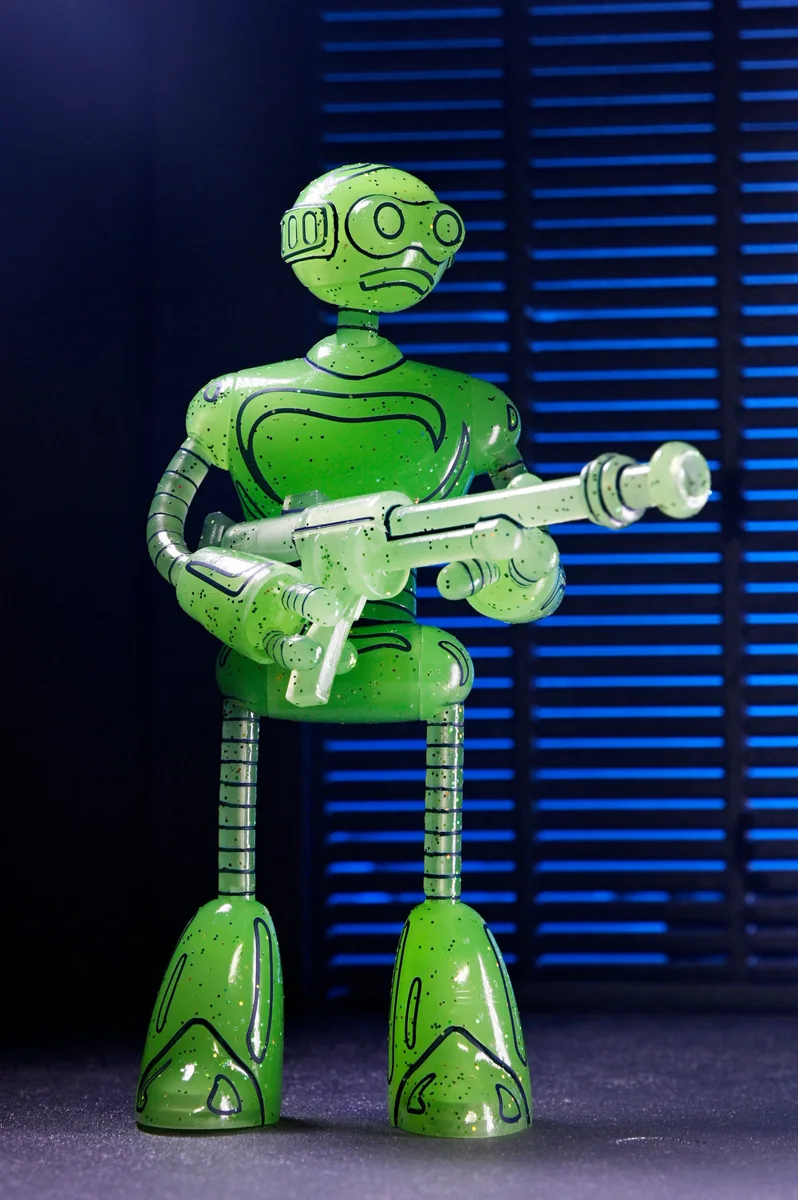
Transmat, 2025. The glow-in-the-dark variant represents teleportation. Its distinguishing feature is the luminous finish, rather than a new origin or incarnation of Honeycutt. Announced in March 2025, it continues the Mirage-based visual approach.
Fugitoid facts that put his history in perspective
- His development and debut are different events. Laird’s 1983 letter predates the 1984 printed appearance.
- The big panels had a practical purpose. The abandoned foldout format helps explain the 1985 one-shot’s page compositions.
- “First full-color cover” is a specific distinction. Early TMNT covers already used red; Fugitoid did not introduce all color to Mirage publishing.
- Toy biographies are not universal canon. Weapons, statistics, and jokes on a package do not automatically apply to the comics or cartoons.
- A toy influenced a later comic. Joustra identified the vintage figure as a reference for the gold-and-black Tales incarnation.
Eastman and Laird’s admiration for Jack Kirby is documented in Mirage’s history. A specific Doc Brown influence on Honeycutt is unsupported and clashes with the timeline: Fugitoid was in development before Back to the Future opened in 1985. Resemblances to other science fiction robots can be useful comparisons without being established creative influences.
Why Fugitoid matters to TMNT
Honeycutt connects Eastman and Laird’s earliest collaborations with the much larger world that grew around the Turtles. He also offers a different kind of heroism: his central problem is how to keep his knowledge from being used to destroy other people.
That is why he remains recognizable through changes in age, homeworld, and design. Inside the metal is someone who still has to decide what to do with what he knows.
Sources and further reading
- Mirage: Fugitoid #1 credits and synopsis; TMNT #5; volume 1 history and catalog.
- Peter Laird’s 1983 letters and recollections of the foldout format.
- TMNT Entity: IDW microseries; #56; #73.
- Re-Evolution #2 and Honeycutt’s role.
- Andrew Joustra and Louie Joyce interview; IDW / PRH: Fugitoid Frenzy.
- Paramount+: Worlds Collide; Nickelodeon’s space season and David Tennant announcement.
- GameSpot’s Fugitoid hands-on for Smash-Up; community Legends roster; Mutant Madness character catalog.
- Product photographs and covers are credited beside each image and identify the works and figures discussed. Rights remain with their respective owners.